

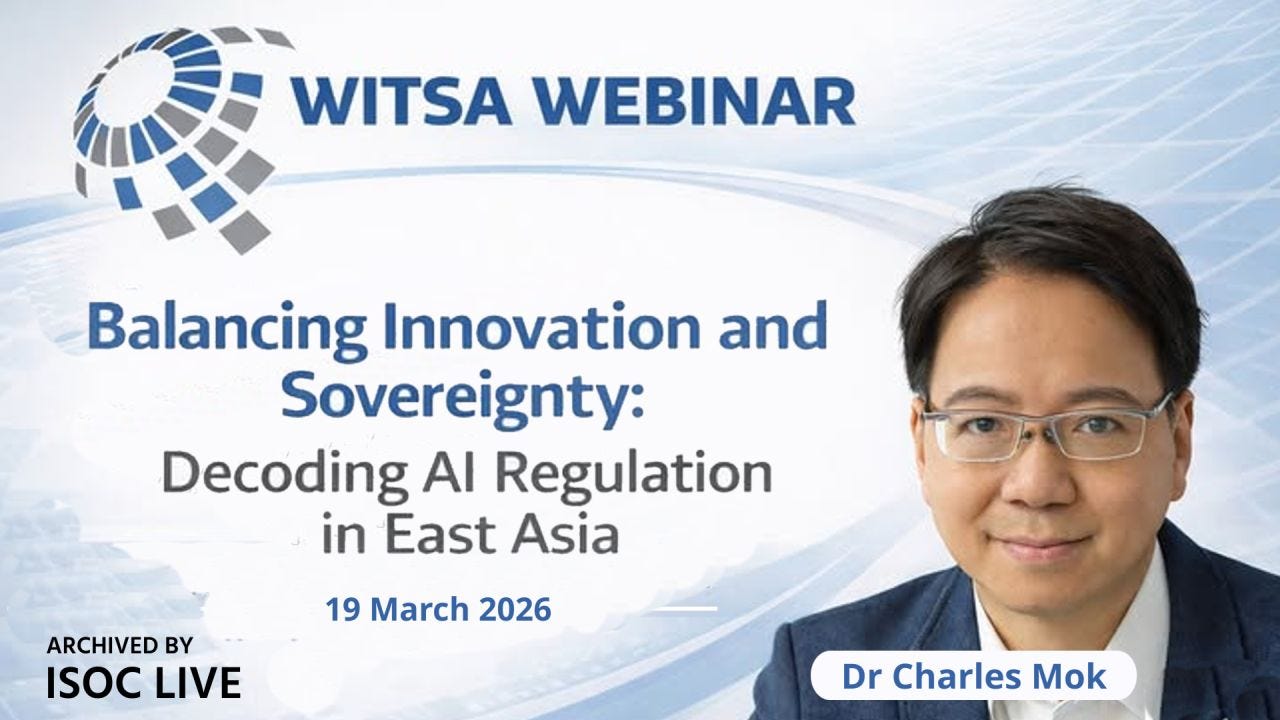
Balancing Innovation and Sovereignty -- Decoding AI Regulation in East Asia
World Innovation, Technology and Services Alliance (WITSA) - March 19, 2026
VIDEO | AUDIO | RECAP EN / ES / FR | ARCHIVE | PERMALINK
Speaker: Charles Mok - Research Scholar, Stanford University
Moderator: Anders Halvorsen - Vice President, Public Policy, WITSA
Opening Remarks
WITSA CEO Dato’ Dan E. Khoo welcomed participants and framed the session around the growing tension between technological innovation and national sovereignty in AI governance. He emphasized that East Asia has become a critical testing ground where governments are simultaneously encouraging AI development while constructing regulatory systems around data, algorithms, and cross-border information flows. He argued that these policies are increasingly shaping competitiveness, investment patterns, and geopolitical alignment, making AI regulation not merely a technical issue but a defining structural force in the future digital economy.
Anders Halvorsen introduced Charles Mok as a long-time Internet governance and policy figure with experience spanning entrepreneurship, public office, and international governance institutions. He highlighted Mok’s role as a co-founder of HKNet, his service in Hong Kong’s Legislative Council, and his work with Stanford University’s Global Digital Policy Incubator. Halvorsen positioned Mok as uniquely qualified to analyze how Asian economies are navigating the competing influence of China, the United States, and Europe in AI governance.
The Three Global Models of Digital and AI Governance
Charles Mok began by outlining what he described as the three dominant models of digital governance, derived from Professor Anu Bradford’s concept of “digital empires.” He explained that these models increasingly form the basis of global AI governance as well.
He described the United States model as market-driven and innovation-centric, with Silicon Valley culture often treating regulation as fundamentally opposed to innovation. However, Mok argued that despite rhetoric about minimal regulation, the U.S. government still exerts significant influence through industrial policy, geopolitical pressure, and growing state-level AI regulation efforts. He contrasted the Biden administration’s focus on AI safety with the newer administration’s emphasis on AI dominance and global competitiveness.
He then examined the European Union’s rights-based approach, rooted in privacy protections, democratic accountability, and consumer rights. Mok described GDPR as the global benchmark for privacy legislation and explained how the “Brussels Effect” has historically allowed Europe to influence global platform behavior despite lacking dominant global tech platforms of its own. However, he noted emerging internal fractures within Europe, with countries like France and Germany increasingly questioning whether heavy regulation may inhibit innovation competitiveness.
Mok described China’s model as state-driven and ideologically centralized, emphasizing planned economic coordination, national security priorities, surveillance capabilities, and the export of Chinese digital governance approaches to Global South countries through initiatives linked to the Digital Silk Road. He argued that China increasingly frames AI governance around sovereignty, strategic independence, and geopolitical influence.
East Asia Between the U.S. and China
Mok argued that Asian economies are increasingly squeezed between the geopolitical and technological influence of the United States and China. He described AI governance decisions as no longer purely technical or economic, but inherently political. Countries are being pressured to align technologically, strategically, and economically with one side or the other.
He distinguished between economies such as Japan, South Korea, and Taiwan, which occupy critical positions in the global semiconductor and technology supply chain, and other “middle powers” that may instead seek to climb the AI value chain through selective specialization or AI adoption strategies. He emphasized that AI sovereignty is becoming a central policy objective across Asia, with governments increasingly seeking domestic AI models and infrastructure tailored to local languages, cultures, and security priorities.
Mok contrasted this with the earlier Internet era, where policymakers largely operated under the principle of “one world, one Internet.” In the AI era, he suggested the emerging mentality is increasingly “one country, one AI.”
South Korea’s Aggressive Regulatory Approach
Mok identified South Korea as an outlier in East Asia because of its comparatively aggressive regulatory posture. He argued that Korea’s regulatory culture reflects longstanding protectionist tendencies and close coordination between government and major domestic conglomerates, or chaebols. Unlike many Asian countries that rely heavily on foreign platforms, Korea retains strong domestic digital platforms and therefore has a greater incentive to regulate in ways that protect local industry interests.
He discussed Korea’s Basic Act on AI, passed earlier in 2026, which established categories of “high-impact AI applications” involving areas such as healthcare, transportation, finance, water systems, and nuclear safety. The law mandates human oversight, user notifications, and protection plans for AI systems in these sectors. Mok noted that industry groups considered parts of the legislation vague and potentially difficult to implement.
Mok connected Korea’s legislative style to the country’s highly competitive democratic politics, arguing that politicians often pursue highly visible regulatory actions to demonstrate responsiveness to public concerns. However, he also noted that many past Korean digital regulations were later weakened, overturned, or declared unconstitutional after implementation challenges emerged.
Japan’s “Soft Law” Strategy
Mok described Japan as pursuing the opposite strategy from Korea. Japan, he explained, has consistently framed its AI governance approach around “light-touch” regulation and voluntary frameworks. He referenced research suggesting that Japanese society tends to be more optimistic about AI’s social benefits than many Western populations, making the public less focused on AI ethics concerns.
At the same time, he noted that Japan has become more active in platform regulation and antitrust enforcement, particularly regarding Google, partly to support domestic technology firms such as Yahoo Japan. Mok characterized these efforts as driven more by competition and industrial policy concerns than by user protection principles.
He also highlighted Japan’s active participation in international AI governance efforts through the OECD AI Principles and the G7 Hiroshima AI Process. Mok noted Japan’s growing strategic alignment with the United States on semiconductors, AI supply chains, and critical technologies.
Taiwan’s AI Governance and Sovereignty Strategy
Mok explained that Taiwan’s AI Basic Act, passed in late 2025, primarily establishes governmental authority structures rather than imposing strict enforcement measures. The law assigns responsibilities across agencies such as the National Science and Technology Council and the Ministry of Digital Affairs while requiring the government to address data governance, open data, and risk assessment.
He characterized Taiwan’s approach as cautious and innovation-oriented, reflecting Taiwan’s broader historical difficulty with digital policy enforcement. Mok noted that Taiwan has experienced significant data breaches in recent years, contributing to limited public confidence in digital regulation.
At the same time, Taiwan has invested heavily in sovereign AI development, including funding for AI models, silicon photonics, robotics, drones, and quantum computing. Mok described these efforts as attempts to replicate Taiwan’s semiconductor success in the AI era.
India’s Innovation-First Position
Mok described India’s approach as strongly innovation-oriented and intentionally cautious about regulation. He referenced statements by Indian officials emphasizing that India does not seek to “lead in regulations” but instead prefers lightweight governance and adaptation of existing laws where necessary.
He discussed India’s AI Impact Summit, which featured major global AI company leaders and positioned India as an emerging global player in AI governance discussions. Mok noted that while private legislative proposals concerning AI ethics and accountability have been introduced, the Indian government has thus far emphasized industry growth, domestic AI models, and AI development centers rather than comprehensive AI regulation.
Singapore’s Pragmatic Hub Strategy
Mok explained that Singapore continues to approach AI through the lens of economic competitiveness and industry development. Rather than attempting to compete with larger AI powers directly, Singapore aims to position itself as a trusted AI hub and global testing ground.
Singapore has launched national AI strategies, AI research plans, and proposals for a National AI Council, while largely avoiding comprehensive AI legislation. Instead, sector-specific regulators such as the Monetary Authority of Singapore are responsible for establishing governance principles and standards within their domains.
Vietnam’s Enforcement-Oriented Model
Mok concluded his country survey with Vietnam, which he described as Southeast Asia’s first country to adopt a dedicated AI law modeled partly on the EU approach. Vietnam established a three-tier risk classification system and imposed requirements involving lifecycle risk management, safety assurance, local representatives for foreign firms, and pre-market conformity assessments.
He noted that Vietnam’s definitions and penalty structures remain somewhat unclear, but characterized the country as taking a distinctly enforcement-first approach while simultaneously creating AI development funds and innovation support programs.
Consumer Protection, Sovereignty, and Fragmentation
Mok observed that many Asian countries generally provide weaker consumer protections than Western democracies and often exempt government authorities from liability in AI governance laws. He warned that this could leave the public with limited remedies when harms occur.
He also argued that AI sovereignty is changing perceptions about digital fragmentation. Whereas Internet fragmentation was previously viewed negatively, sovereign AI development is increasingly seen as legitimate and necessary because countries want culturally and linguistically appropriate AI systems.
Mok concluded his formal presentation by inviting participants to consider what approaches their own governments should adopt and what lessons could be drawn from the diverse Asian regulatory experiments he had outlined.
Discussion on Taiwan, Korea, and Regulatory Tradeoffs
During the Q&A session, Anders Halvorsen asked whether Taiwan’s innovation-first AI Basic Act could serve as a model for other countries or whether it risked creating legal uncertainty. Mok responded that Taiwan’s cautious approach reflected its weak historical track record in digital regulation enforcement. He argued that rushing into strict regulation could create more problems than benefits in Taiwan’s context, though public backlash could eventually force stronger regulation if harms such as fraud and privacy abuses increase.
Halvorsen also questioned whether South Korea’s prescriptive regulatory mandates represented an effective model. Mok argued that Korea’s approach reflected populist political incentives and a desire to appear globally pioneering. However, he warned that unclear legal definitions and rapidly evolving AI technologies could make such regulations difficult to enforce. He noted that large companies often possess the legal resources to withstand prolonged disputes, while smaller innovators may suffer disproportionately under uncertain regulatory systems.
Global Governance and Multistakeholder Challenges
A participant asked whether any international body exists that could convene governments, civil society, and industry around AI governance. Mok referenced ongoing discussions within the Internet Governance Forum and United Nations AI expert initiatives, but argued that meaningful multistakeholder influence remains difficult within formal intergovernmental structures.
He suggested that industry groups, civil society organizations, and technical communities may need to develop voluntary declarations or best-practice frameworks independently and then lobby governments collectively. However, he also acknowledged the difficulty of achieving consensus even among major AI companies themselves.
Australia, Overregulation, and Common Frameworks
Elizabeth “Izzy” Whitelock, CEO of the Australian Information Industry Association (AIIA), joined the discussion and described Australia as prone to overregulation and slow policy development. She criticized Australia’s age verification initiatives as politically motivated and ineffective, noting that children had already found ways around the systems.
Whitelock expressed interest in developing common regional frameworks and educational initiatives that could help align government and industry perspectives across Asia-Pacific countries. Mok agreed that coordinated industry and civil society voices could help resist divisive policymaking and create more coherent approaches to AI governance.
The Future of Fragmented AI Ecosystems
Dato’ Dan E. Khoo closed the substantive discussion by asking whether growing digital sovereignty trends could force companies to create parallel AI products and technology stacks for different regulatory regions. Mok responded that fragmentation is likely to increase beyond the original “three digital empires” framework, potentially evolving into “one country, one AI rule.”
However, he suggested that AI technologies may prove more adaptable to fragmentation than earlier Internet platforms because localized AI models are already expected and often desirable. Open-source AI and locally tailored systems may therefore make fragmentation more technologically manageable than the earlier era of global Internet platforms.
The webinar concluded with thanks from WITSA leadership and confirmation that the session recording and summary would be distributed to participants.
RESOURCES
WITSA — World Innovation, Technology and Services Alliance, host of the webinar
Charles Mok — Research Scholar, Global Digital Policy Incubator, Stanford Cyber Policy Center; Internet Society trustee
Digitally Yours — Mok’s Substack on digital policy, infrastructure, and East Asian geopolitics
Personal Data & AI Governance in East Asian Countries — Mok’s recent article cited in the webinar findings
South Korea May Regret Being First with New AI Law — Mok’s article on the Korean AI Basic Act, the basis for his Korea section
Taiwan’s AI Basic Act Can Be a Model for Asia — Mok and Wesley Chu on Taiwan’s “soft law” approach
Japan’s Pragmatic Model for AI Governance — Mok & Tong paper on Japan’s regulatory approach
Stanford Cyber Policy Center — host institution for Mok’s AI governance research
Internet Society — global nonprofit on whose Board of Trustees Mok serves
Digital Empires: The Global Battle to Regulate Technology — Anu Bradford’s book framing the three-empires model (US, EU, China) referenced throughout
AIIA — Australian Information Industry Association, respondent Whitelock’s organization