

Alexander Graham Bell’s Telephone Patent: 150 Years, A World of Connection
United States Patent and Trademark Office (USPTO) – March 5, 2026
VIDEO | ARCHIVE | PERMALINK
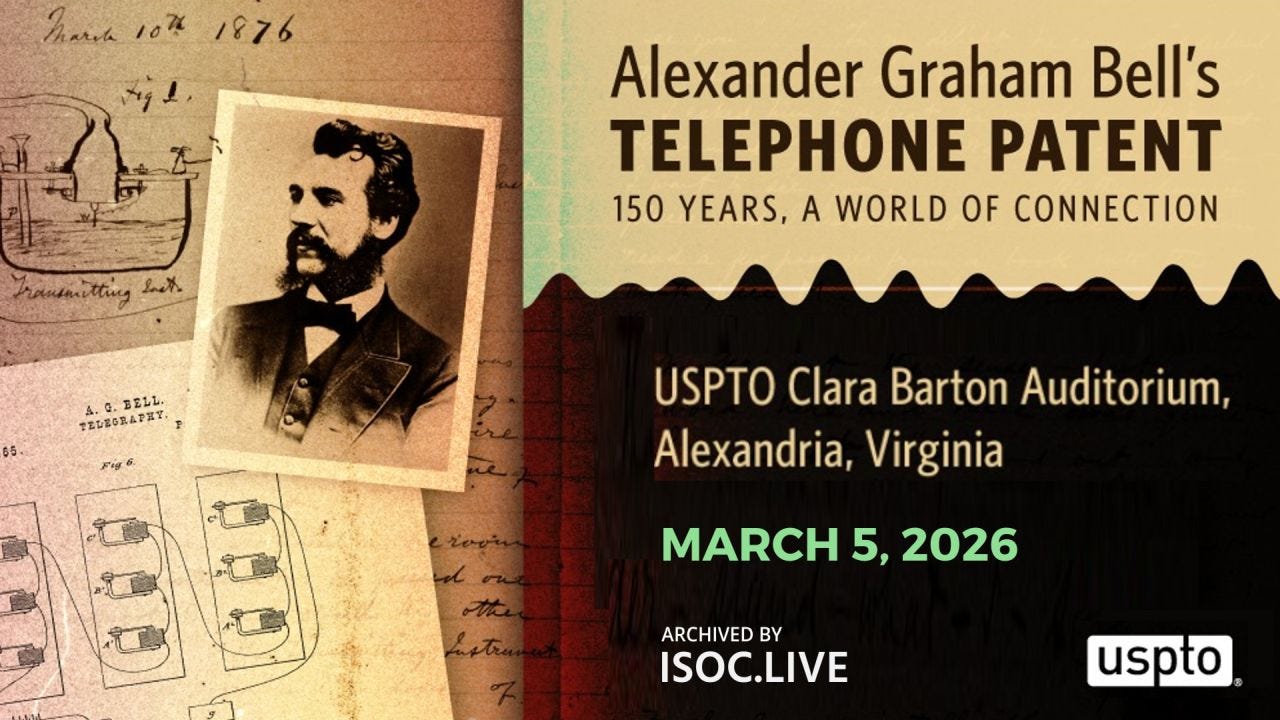
The United States Patent and Trademark Office hosted a commemorative event marking the 150th anniversary of Alexander Graham Bell’s telephone patent (granted March 7, 1876). The program brought together historians, technologists, policy experts, and descendants of the Bell family to reflect on the invention of the telephone, its impact on communications and society, and the continuing role of intellectual property in shaping innovation.
The event featured opening remarks, two thematic panels, and closing reflections connecting Bell’s legacy with modern digital communications.
Opening Remarks
VIDEO | AUDIO | RECAP EN / ES / FR
Opening speakers set the historical context for Bell’s invention and emphasized the role of the patent system in enabling innovation. They highlighted how the 1876 patent did more than introduce a new device—it helped launch the global telecommunications industry and a century and a half of technological transformation.
Speakers framed the telephone as one of the major inflection points in the history of communication, alongside the telegraph, radio, and later the Internet. They noted that Bell’s achievement combined scientific insight, entrepreneurial support, and the legal protection of intellectual property, illustrating the interplay between invention and the systems that allow innovation to flourish.
Panel I: From Bell to Broadband — Innovation and Industry Across 150 Years
VIDEO | AUDIO | RECAP EN / ES / FR
The first panel explored the historical development of the telephone and the evolution of telecommunications from Bell’s early experiments to modern broadband networks.
Panelists discussed Bell’s early influences, including his family’s work in elocution and deaf education. His fascination with sound and speech—combined with experiments on acoustics and resonance—shaped his understanding of how voice might be transmitted electrically.
Bell’s move from Britain to Canada for health reasons proved pivotal. The quiet environment of the Bell family’s homestead near Brantford, Ontario became what Bell called his “dreaming place,” where he developed the principle of transmitting speech through an undulating electrical current.
The panel examined the collaborative and financial relationships that helped bring the telephone into existence. Gardner Hubbard, father of Bell’s future wife Mabel, encouraged Bell to pursue electrical communication technologies while trying to break the Western Union telegraph monopoly. Bell’s experiments with the harmonic telegraph—designed to send multiple signals over one wire—ultimately led to the breakthrough concept behind the telephone.
Panelists also discussed the dramatic patent race between Bell and inventor Elisha Gray, who filed a caveat for a similar idea on the same day Bell’s patent application was submitted. The resulting patent disputes eventually produced hundreds of legal cases, but the U.S. Supreme Court ultimately affirmed Bell’s priority and the foundational nature of his patent.
Early demonstrations of the telephone were also examined. While Bell’s famous first call occurred on March 10, 1876 between two rooms, a later demonstration in Brantford used telegraph lines to conduct one of the first long-distance calls between towns. Public tests showed that the device could function as a practical communications system rather than a laboratory curiosity.
The panel then explored the rapid expansion of the telephone network after the Bell Telephone Company was formed in 1877. Innovations such as the telephone switchboard, franchised exchanges, and improvements in long-distance transmission transformed the telephone from a novelty into an essential infrastructure.
Participants also noted the social changes introduced by the telephone. Unlike the telegraph, which required trained operators and telegraph offices, the telephone allowed direct person-to-person communication. It brought voices into homes and businesses, creating a more immediate and intimate form of communication.
Finally, panelists reflected on the broader trajectory of telecommunications innovation. The early telephone network evolved through thousands of additional inventions—from switching systems and long-distance transmission technologies to modern digital networks. These developments ultimately led from wired telephony to today’s mobile and broadband communication systems.
Panel II: Protecting Ideas and Shaping the Future — Intellectual Property and the Next 150 Years
VIDEO | AUDIO | RECAP EN / ES / FR
The second panel focused on the role of intellectual property in enabling technological progress and shaping future innovation.
Speakers examined how Bell’s telephone patent illustrates the power of strong intellectual property protection in attracting investment, encouraging commercialization, and fostering entire industries. The patent not only protected Bell’s discovery but created a framework for businesses to develop and expand telecommunications infrastructure.
Panelists discussed the balance between open innovation and patent protection in modern technological ecosystems. While patents provide incentives for invention and commercialization, collaboration and shared standards often accelerate the adoption of new technologies.
Examples were drawn from modern communications technologies such as the Internet, mobile networks, and digital platforms, where innovation often emerges through complex interactions between researchers, entrepreneurs, corporations, and regulatory systems.
Participants also explored the growing challenges facing the intellectual property system as emerging technologies—including artificial intelligence, software platforms, and digital communication tools—generate new kinds of inventions. Patent systems must continually adapt to evaluate increasingly complex and interdisciplinary innovations.
The discussion emphasized that the next 150 years of communications technology will likely involve similar dynamics: breakthroughs driven by individuals and teams, supported by intellectual property frameworks that encourage experimentation, investment, and technological diffusion.
Closing Reflections & Anniversary Tribute
VIDEO | AUDIO | RECAP EN / ES / FR
The final session combined historical reflection with perspectives on the future of communication technologies.
Sara Grosvenor, a descendant of Alexander Graham Bell and president of the Alexander and Mabel Bell Legacy Foundation, highlighted the partnership between Bell and his wife Mabel. She described Bell as an inventor driven by relentless curiosity who continued exploring new fields long after inventing the telephone.
His later work included the photophone, which transmitted sound via beams of light and anticipated fiber-optic communication; the graphophone sound recorder; aviation experiments including the Aerial Experiment Association; and hydrofoil boat designs that set speed records and influenced modern marine engineering.
Grosvenor emphasized Mabel Bell’s critical role as collaborator, organizer, and supporter of Bell’s research. Deaf from childhood, she helped manage the family’s finances and played a decisive role in launching early aviation experiments, demonstrating the importance of partnership in innovation.
Vint Cerf then reflected on how Bell’s invention connects to later milestones in communication technology, including the Internet. He noted that each major technological shift—from telegraph to telephone to Internet to mobile networks—expanded the ability of people to communicate directly and instantly.
Cerf highlighted the importance of open technological architectures, explaining that the core Internet protocols (TCP/IP) were intentionally not patented so that others could innovate freely on top of them. This approach helped accelerate global adoption and enabled the explosive growth of Internet-based technologies.
He also described how communication technologies increasingly blur the boundary between human and machine interaction. Artificial intelligence systems and automated software agents now communicate using human language and digital interfaces, suggesting that future innovation may involve increasingly autonomous digital systems.
Cerf concluded with a personal story about his wife’s cochlear implant, which restored her ability to hear and make telephone calls after decades of deafness. The story illustrated how modern technologies continue to build upon the scientific foundations laid by earlier inventors like Bell.
Conclusion
The event concluded with reflections from the USPTO emphasizing that Bell’s invention demonstrates the transformative power of curiosity, persistence, and collaboration. The telephone not only revolutionized communication but inspired generations of inventors to build upon its foundations.
Participants were reminded that every major technological advance—like Bell’s telephone—begins with a simple question and the willingness to imagine a new way to connect people.