

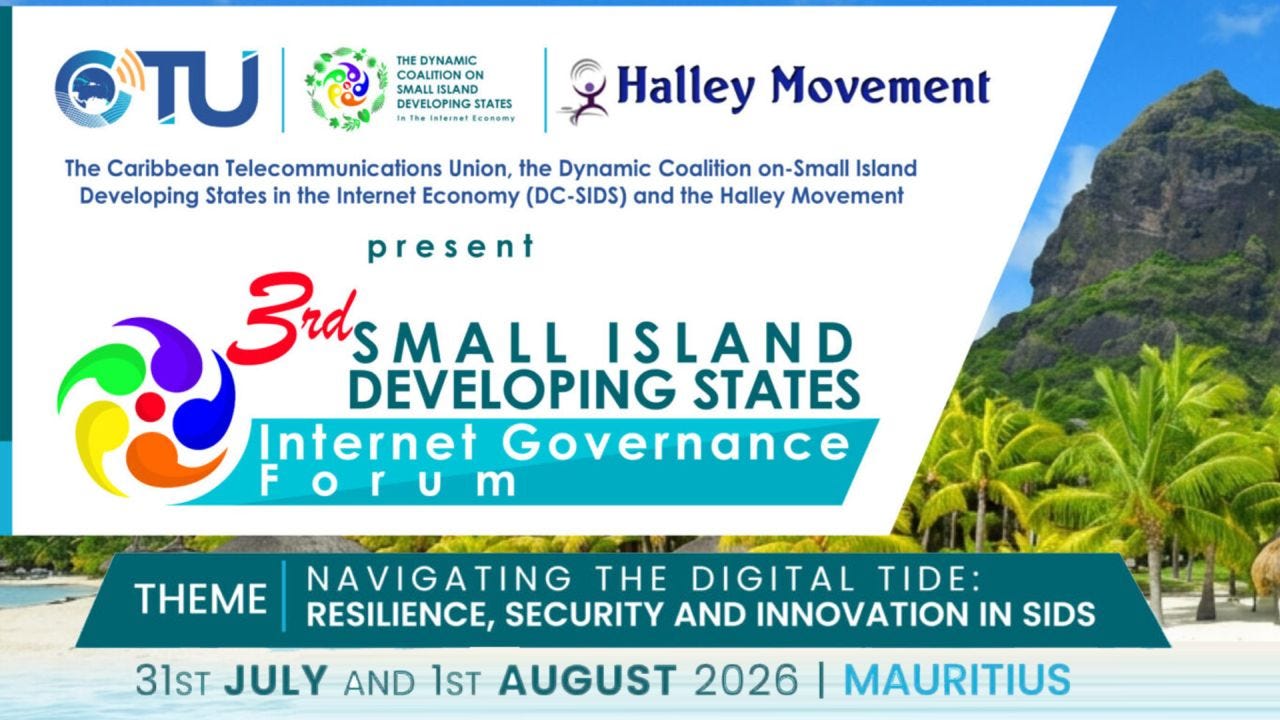
3rd Small Island Developing States Internet Governance Forum
Mauritius - 31 July - 1 August 2026
VIDEO | RECAP EN / ES / FR | ARCHIVE | PERMALINK
Opening Remarks
The forum opened by celebrating the first in-person SIDS IGF convened in the Indian Ocean, bringing together participants from the Caribbean, Pacific, Indian Ocean, Africa, and beyond under the theme Navigating the Digital Tide: Resilience, Security and Innovations in SIDS. Leena Devi Boodhoo framed the two days around three questions: how to build trusted and secure digital infrastructure, how to close governance gaps affecting vulnerable communities, and how SIDS can shape global Internet governance rather than simply inherit it.
Mahendra Busgopaul set out the forum’s four themes — charting our own course, building interconnected resilience, leapfrogging safely, and forging a trusted and ethical Internet. Nigel Cassimire traced the forum’s evolution from discussions begun in 2011, through the creation of DC-SIDS in 2018, to the first SIDS IGF in Trinidad and Tobago in 2022 and the second in Antigua and Barbuda in 2024.
Hon. Lutchmanah Raj Pentiah described Mauritius’ own public service transformation through electronic human resources, scheme of services, and document management systems, alongside plans to train over 50,000 people in AI and digital technologies within five years, stressing that artificial intelligence should strengthen rather than replace public servants.
VIDEO | RECAP EN / ES / FR
Fireside Chat: Why the IGF matters for SIDS
A fireside conversation explored why sustained participation in the Internet Governance Forum is essential for small island developing states. Jennifer Chung explained the role of the IGF Multistakeholder Advisory Group and welcomed the WSIS+20 decision making the IGF a permanent United Nations forum. Olaf Kolkman described this as a strong endorsement of the multistakeholder model that has enabled the Internet’s global development, and argued that island communities — recently connected, speaking languages absent from today’s AI systems — hold experience essential to connecting the last billion.
Rather than viewing participation as attendance at an annual meeting, both speakers encouraged continuous engagement through national and regional IGFs, youth fellowships, and policy networks. Chung proposed two concrete measures of success: hosting a future global IGF in a SIDS country, and seeing the learnings of successive SIDS IGFs carried into the global IGF’s dialogue and intersessional work.
VIDEO | RECAP EN / ES / FR
The Digital Leap: Transforming SIDS through Secure, Resilient, and Smart Technologies
This session examined how SIDS can leapfrog traditional development pathways using digital public infrastructure, artificial intelligence, cloud services, and secure logistics systems. Tracy Hackshaw focused on cybersecurity across the growing delivery economy, describing the Universal Postal Union’s SECURE.POST and POST-ISAC initiatives and arguing that postal operators, logistics providers, and other participants must share threat intelligence to defend an increasingly interconnected supply chain. Russell Woruba presented digital public infrastructure as the foundation for efficient government services and argued that institutional capacity matters more than technology alone.
Discussions also explored data sovereignty and localization, regional data hubs or “data embassies” serving neighbouring states, cloud governance, protection of submarine cables as critical national infrastructure, and the legal frameworks without which an attacked state has no basis on which to attribute the act. Speakers consistently emphasized that resilient institutions and regional cooperation are prerequisites for successful digital transformation.
VIDEO | RECAP EN / ES / FR | SLIDES
Forging a Resilient and Trusted Internet for SIDS
An interactive discussion focused on the practical barriers preventing SIDS from achieving stronger cyber resilience. Participants identified political will, trust, culture, technical capacity, long-term planning, and affordable technology as recurring challenges, with Cherie Lagakali arguing that the region has learned to coordinate but not yet to genuinely collaborate. Shernon Osepa identified political will as the decisive missing ingredient and proposed formal multiregional agreements, thematic working groups, shared knowledge hubs, pooled procurement, centres of excellence, and harmonized standards.
Lagakali described Pacific initiatives ranging from cyber drills and operational networks to digital public infrastructure and university engagement, and offered the session’s one concrete policy proposal: obliging mobile network operators to build protection into their services rather than leaving the onus on individual users. The session closed with a call to pursue a small number of achievable regional initiatives that demonstrate measurable progress, and to give economic development a far more prominent place alongside cybersecurity.
VIDEO | RECAP EN / ES / FR
From Climate Frontlines to Cyber Frontiers
Speakers demonstrated that climate resilience and cyber resilience have become inseparable for small island developing states. Digital infrastructure now underpins disaster response, weather forecasting, emergency communications, healthcare, banking, and public administration, making it vulnerable to both natural hazards and cyber threats.
Dr. Arlene Laing described the Caribbean’s extensive regional meteorological cooperation, including mirrored databases, backup forecasting responsibilities shared between neighbouring countries, and satellite communications, illustrating with Hurricane Melissa how an airport cannot reopen without observers and forecasts however serviceable its runway. Ewan Cameron highlighted similar approaches across the Pacific, noting that cyclones can disable digital services without any cyberattack occurring. Both argued that climate adaptation and cybersecurity require common strategies built around redundancy, risk assessment, contingency planning, and regional cooperation.
Albert Daniels and Nigel Cassimire proposed carrying climate resilience into global Internet governance discussions through ICANN — including the SIDS session planned for Bali — and the broader IGF community.
VIDEO | RECAP EN / ES / FR | SLIDES
Charting Our Own Course: Digital Governance, Security, and Innovation in Small Island States
The forum’s concluding panel examined how SIDS can define their own digital futures while preserving local cultures and empowering future generations. Ian Tairea illustrated how Starlink-enabled connectivity is creating economic opportunity, digital education, and smart agriculture on Mauke, a Cook Islands island of roughly 250 people, while also offering tools to preserve indigenous languages and cultural knowledge through self-hosted AI models and locally controlled data. SarahJane Pierre called for meaningful youth participation in policymaking rather than symbolic representation.
Nigel Cassimire highlighted regional cooperation through the Caribbean Telecommunications Union and the Caribbean AI Task Force, established in September 2025 and chaired by Dr. Craig Ramlal, whose final report — built on seven strategic pillars — was launched at the first Caribbean AI Forum in Trinidad and now proceeds to the CTU’s conference of ministers in French Guiana. Kailash Busgopaul emphasized that youth engagement must remain central to future SIDS initiatives, and Claire Craig cautioned that digital inclusion must extend to older people, who hold the cultural knowledge these technologies are meant to preserve.
The discussion concluded that every SIDS should identify its own weakest link and start there, while working collectively to influence global digital governance.
VIDEO | RECAP EN / ES / FR
Mauritius IGF Closing Remarks & Call to Action / Closing DC-SIDS IGF
Organizers reflected on the forum as a milestone that united the Caribbean, Pacific, and Indian Ocean around a common digital agenda. Nigel Cassimire reaffirmed the value of continued collaboration among the Caribbean Telecommunications Union, DC-SIDS, and the Halley Movement, noting that the fourth SIDS IGF is currently scheduled for 2028 — though the pace of digital policy change may justify meeting more often — and that the Pacific has yet to host.
Tracy Hackshaw urged participants to move “from coordination to true collaboration” by implementing the practical recommendations developed during the event, and to ensure that digital infrastructure investment is both climate resilient and cyber secure. Rodney Taylor pointed to a Caribbean candidature for Deputy Secretary-General of the International Telecommunication Union, to be decided at the Plenipotentiary Conference in November, as an illustration of what SIDS can achieve through collective action given each member state’s equal vote. Kailash Busgopaul celebrated both the tenth Mauritius IGF and the first Indian Ocean edition of the SIDS IGF.
The forum closed with a shared commitment to expand youth participation, strengthen regional partnerships, and ensure that SIDS continue shaping the future of global Internet governance through practical cooperation rather than dialogue alone.
VIDEO | RECAP EN / ES / FR
RESOURCES
3rd SIDS IGF — event page for the Mauritius forum, hosted by the CTU
Caribbean Telecommunications Union — co-organizer; CARICOM’s specialist agency for ICT, represented by Nigel Cassimire and Rodney Taylor
DC-SIDS Collaborative Platform — the Dynamic Coalition co-chaired by Tracy Hackshaw and Maureen Hilyard
Halley Movement Coalition — Mauritius host coalition, also convenor of the tenth Mauritius IGF
WSIS+20 and IGF+20 Review — the review that made the IGF a permanent UN forum, discussed by Jennifer Chung and Olaf Kolkman
SECURE.POST — the UPU cybersecurity portal Tracy Hackshaw opened to the postal and logistics sector
2050 Strategy for the Blue Pacific Continent — the framework behind the Pacific initiatives Cherie Lagakali described
Caribbean Meteorological Organisation — Dr. Arlene Laing’s organization, coordinating meteorology across 16 member states
Caribbean AI Task Force final report — the seven-pillar report Nigel Cassimire outlined, launched at the first Caribbean AI Forum
ITU PP-26 candidates — the Deputy Secretary-General race behind Rodney Taylor’s call for SIDS to vote together