

Radical Infrastructure: Imagining the Internet from the Ground Up
An ISOC LIVE Summary
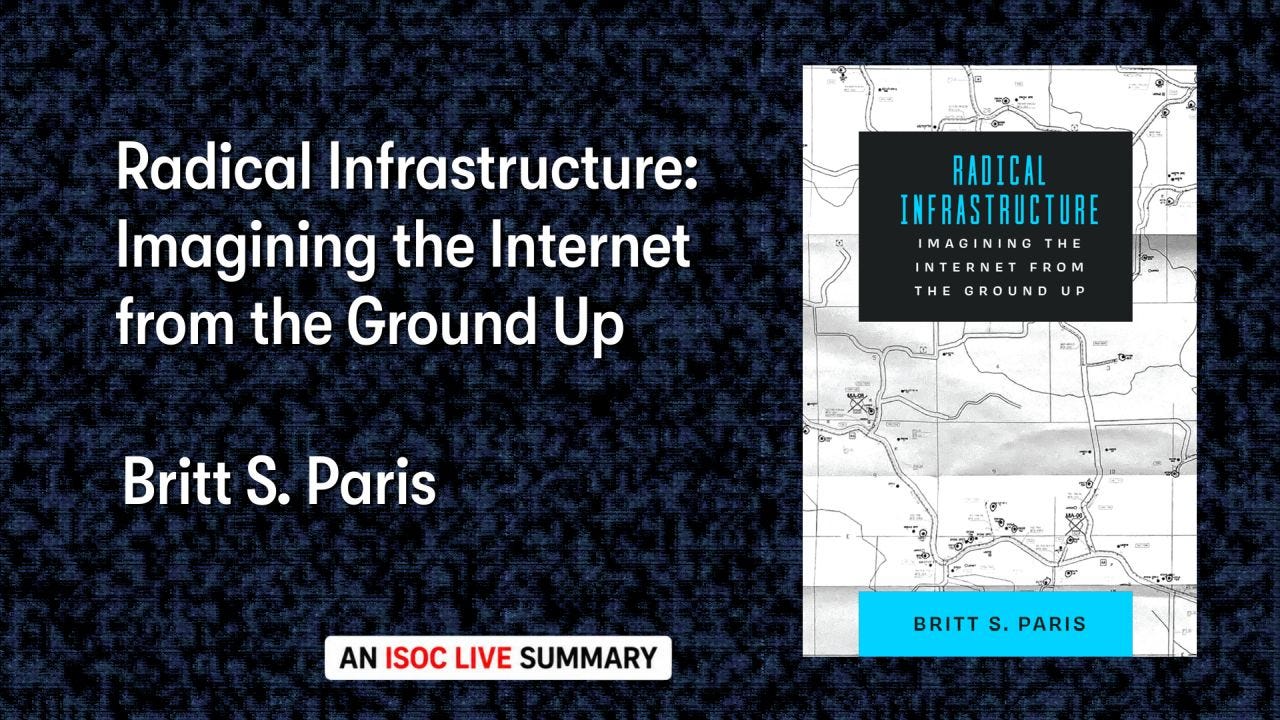
Radical Infrastructure: Imagining the Internet from the Ground Up
Author: Britt S. Paris Published: Feb 2026
Britt S. Paris’s Radical Infrastructure: Imagining the Internet from the Ground Up examines the Internet not as a neutral technical achievement, but as a political, economic, and material infrastructure shaped by capitalism, extraction, privatization, and unequal power. Drawing from interviews, site visits, policy analysis, infrastructure studies, and personal experience growing up around rural utility cooperatives in northern Missouri, Paris reconstructs how Internet infrastructure became organized around monetization and rent extraction, while also documenting efforts by communities, cooperatives, organizers, and local institutions to imagine and build alternatives.
Rather than concentrating primarily on social media platforms or applications, Paris argues that meaningful understanding of the Internet requires attention to the deeper infrastructural layers beneath the user interface: cables, routers, data centers, exchange points, protocols, service provision, labor systems, and ownership structures. Throughout the book, she repeatedly emphasizes that infrastructure is social as much as technical — built, governed, repaired, and contested by people.
Personal and Historical Framing
In the preface, Paris situates the project within her own experiences growing up in rural Missouri served by Northeast Missouri Rural Telecommunications (NEMR), a cooperative telecommunications provider. She describes participating in distance-learning courses delivered over fiber infrastructure installed by the cooperative, including sitting in the shared “ITV classroom” on September 11, 2001, when her instructor cut the lesson short and streamed CNN coverage into the remote classrooms.
Paris recounts how cooperative systems structured much of everyday life in her community:
electricity through cooperatives
telecommunications through NEMR
agricultural cooperatives serving farmers
She explains that later experiences of economic precarity, debt, urban living, and exposure to privatized infrastructure systems led her to reconsider the relative stability and collective orientation of those earlier cooperative models.
Paris also describes how the political discourse after the 2016 US election reinforced simplistic urban-rural divisions while ignoring shared material concerns around healthcare, infrastructure, dignity, and economic survival. She presents the book as an attempt to examine those shared conditions through the lens of Internet infrastructure.
Internet Infrastructure as a Political Problem
In the introduction, Paris argues that Internet infrastructure is intertwined with many contemporary crises:
surveillance
economic precarity
poisoned information environments
environmental degradation
authoritarianism
monopolization
labor exploitation
She argues that the “ideological core” of Internet infrastructure is the compulsion to monetize, and that this imperative shapes both the technical organization of networks and the social conditions surrounding them.
Paris contrasts her approach with reform proposals focused primarily on regulating applications or platforms such as Meta, X, or Google. While acknowledging those debates, she argues that the roots of these problems lie deeper in infrastructure itself — in the ownership structures, physical systems, standards, and governance models that underpin the network.
She describes the Internet as both:
a technical “network of networks”
a sociotechnical system shaped by labor, policy, economics, and power
Drawing from science and technology studies, Paris explains that infrastructures often become invisible when functioning smoothly, only becoming visible during moments of breakdown, exclusion, or violence. She cites examples where marginalized communities experience infrastructure differently because systems are not designed for them or actively target them.
Historical Development of Network Infrastructure
Paris traces the historical lineage of Internet infrastructure through earlier communication and transportation systems:
postal systems
telegraph networks
railroads
telephony
undersea cable systems
She discusses how packet-switching concepts borrowed organizational ideas from postal routing systems, where information moved through distributed networks based on addressing and sorting procedures.
Paris explains that these earlier infrastructures were deeply tied to imperial expansion, capitalist accumulation, and settler colonialism. Drawing on Rosa Luxemburg, she argues that railroads and communication systems functioned as mechanisms for expanding markets, extracting resources, and reorganizing geographic areas for capitalist development.
She describes how railroads, land speculation, and state-backed infrastructure projects facilitated westward expansion in the United States while simultaneously dispossessing Indigenous communities and reshaping landscapes for industrial agriculture and extraction. These historical patterns, Paris argues, continue to shape contemporary Internet infrastructure development.
Protocols, Layers, and the “Stack”
Paris devotes substantial attention to explaining Internet protocols and infrastructure layers in social and political terms rather than only technical ones. Using the ISO networking stack, she describes how physical cables and signals connect upward through routing and transport layers to user-facing applications.
Rather than treating these layers as neutral abstractions, Paris argues that each layer reflects ownership structures and power relations. She emphasizes that infrastructure throughout the stack is increasingly centralized and owned as rentable property.
She critiques speculative infrastructure discourse that treats “the stack” abstractly while ignoring labor, ownership, and political economy. Instead, she frames infrastructure as a material and social process shaped by institutions, governments, corporations, workers, and users.
Neoliberalism and the “Landlords of the Internet”
Paris situates contemporary Internet infrastructure within the rise of neoliberal political economy beginning in the late twentieth century. She describes neoliberalism as a framework emphasizing:
privatization
deregulation
market expansion
private property rights
state support for markets rather than public provision
Under these conditions, public infrastructure systems were increasingly transformed into assets that could be owned, traded, leased, and monetized.
Drawing on Daniel Greene and Jathan Sadowski, Paris discusses the emergence of “landlords of the Internet” — investment firms and infrastructure owners controlling data centers, cables, exchange points, and connectivity hubs. These actors extract rents from all participants who rely on network infrastructure, often remaining largely invisible to ordinary users.
Paris also examines monopoly broadband markets in the United States, noting that a small number of corporate providers dominate service provision while many households cannot afford available Internet access. She argues that ISPs frequently resist municipal or public alternatives in order to maintain monopoly control.
Environmental and Labor Dimensions
The book repeatedly connects Internet infrastructure to environmental and labor systems. Paris describes how digital systems depend on:
mining
manufacturing
cable trenching
data center construction
maintenance labor
waste disposal
energy-intensive computation
She notes that data centers consume large quantities of electricity and water, while climate change increasingly threatens the physical infrastructure underpinning connectivity itself.
Paris stresses that infrastructure is sustained by human labor that often remains hidden behind narratives of seamless technological convenience. The people mining materials, laying fiber, maintaining systems, and moderating or processing data are integral to the Internet’s operation even as they remain largely invisible in mainstream technological discourse.
Cooperatives and Community Alternatives
A central theme of the book is the examination of cooperatives and community-run infrastructure systems as partial alternatives to market-driven Internet provision. Paris discusses how cooperative systems emerged historically through both grassroots organizing and New Deal infrastructure programs.
She notes that many cooperative and municipal Internet systems continue to operate in rural or underserved regions where corporate providers considered service unprofitable. These projects are presented not as utopian solutions, but as examples showing that infrastructure can be organized differently around collective needs rather than maximum extraction.
Paris also engages critically with the limits of cooperatives under capitalism, drawing extensively on Rosa Luxemburg’s critiques of worker cooperatives and social democracy. She explains Luxemburg’s argument that cooperatives operating within capitalist markets remain constrained by market logic and may ultimately reproduce capitalist pressures internally.
Even so, Paris presents cooperative infrastructure projects as important practical and political experiments that create space for collective control, democratic governance, and different relationships to technology.
Structure of the Book
The table of contents outlines a progression from historical analysis toward contemporary case studies and future imaginaries:
“Networking Futures Past”
“Buried Bodies of Internet Infrastructure”
“Mining Silicon Holler for Alternatives”
“The Struggle Around Municipal Internet”
“Imagining and Managing Relations from the Ground to the Cloud”
“Reading Futures for Internet Infrastructure”
The conclusion focuses on theories of change, organizing tactics, and collective approaches to transforming Internet infrastructure.
Contemporary Political Context
In a final framing section (“On the Current Moment”) written during revisions in 2025, Paris situates the book within the contemporary political environment surrounding AI, platform power, and authoritarian politics. She describes the rapid expansion of AI hype, deregulation, militarization of technology firms, and close relationships between major technology companies and political power.
Paris argues that technology is increasingly politicized and weaponized, making political responses necessary rather than purely technical reforms. She closes by expressing hope that people can use moments of infrastructural rupture and crisis to organize around collective and commons-oriented alternatives.
COMMENTARY
New Books Network — author interview episode on the book’s arguments and case studies
The Daily Targum — Rutgers profile in which Paris explains the “root/radical” title and cooperative case studies
Daniel Greene, “Landlords of the Internet” — the Social Studies of Science paper Paris builds on for internet rentiership
Paris, Cath & Myers-West (2023) — companion New Media + Society article on repoliticizing internet standards
RESOURCES
Radical Infrastructure (Luminos) — free open-access edition of the book
DOI: 10.1525/luminos.261 — canonical citation link
University of California Press — publisher page, print and ebook editions
Britt S. Paris — Radical Infrastructure — author’s project page
Britt S. Paris — Publications — related papers and book chapters
Jathan Sadowski — co-source for the “landlords of the Internet” framing
ILSR Community Broadband — Institute for Local Self-Reliance program on municipal and cooperative networks
CommunityNets — ILSR resource tracking community-owned broadband
Thanks 🙏 for this summary and post J. I expect I will pickup the full read.