

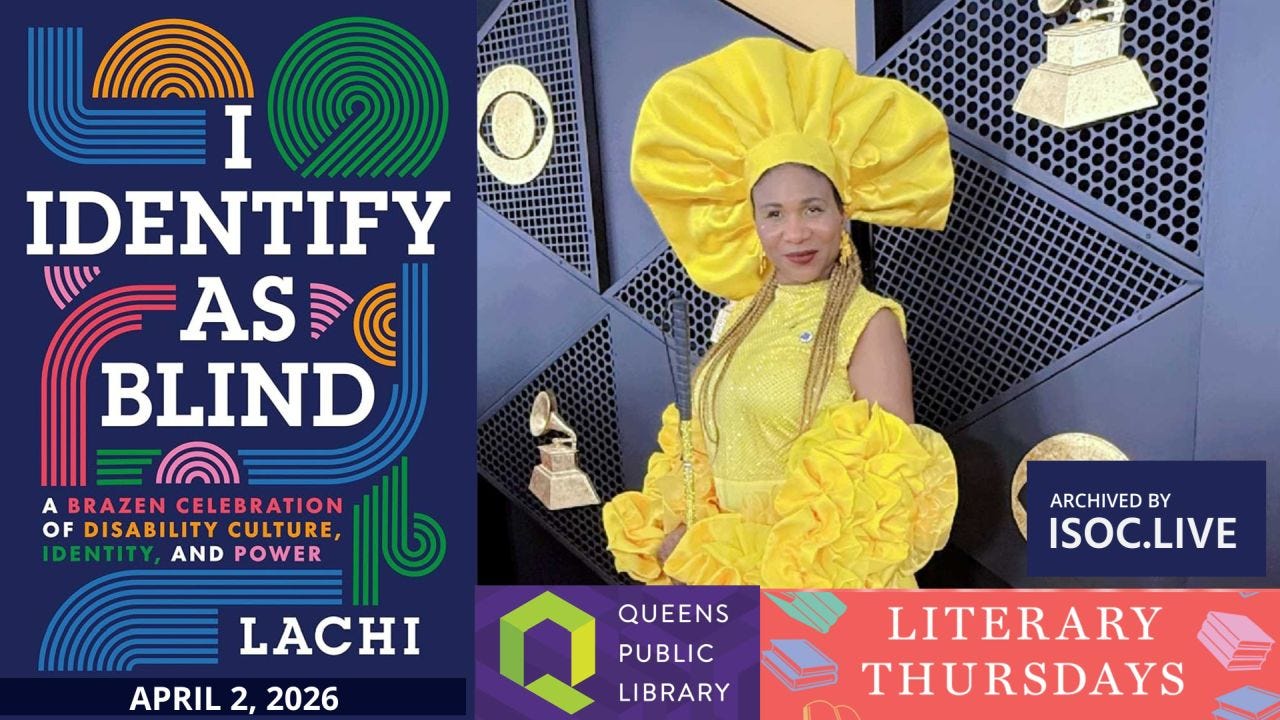
Lachi - I Identify as Blind: A Brazen Celebration of Disability, Culture, Identity and Power
Queens Public Library Literary Thursdays - April 2, 2026
VIDEO | AUDIO | RECAP EN / ES / FR | ARCHIVE | PERMALINK
Simone Wellington opens the session and introduces the program before handing off to Cristina Marie Genao, who provides a detailed introduction of Lachi’s career and impact. Lachi is presented as a multifaceted figure—artist, author, Grammys board governor, and founder of RAMPD—whose work bridges culture, advocacy, and institutional change.
Lachi begins by identifying herself across multiple dimensions—race, gender, disability, and neurodivergence—framing the conversation around identity, pride, and lived experience. She emphasizes that the book is not just informational, but an invitation to rethink disability as something to celebrate rather than conceal.
Genesis of the Book and the Reality of Masking
Lachi explains that the core idea for the book came from recognizing that masking is universal, but particularly prevalent among disabled individuals navigating professional spaces. In her early career, she actively tried to appear “sighted-passing” and non-disabled, which led to both practical and professional limitations.
She describes how:
Avoiding visibility of disability reduced her effectiveness in work environments
Physical navigation without accommodations created unnecessary barriers
Fear of disclosure prevented her from fully participating in opportunities
The turning point came when she began asking for accommodations—not as a political act, but as a practical necessity to perform her job well. Once accommodations were provided, her performance improved, leading to:
Greater confidence and independence
Better professional outcomes and visibility
Increased willingness to advocate for her needs
This experience led to a broader realization: others in the industry were likely masking as well, creating a systemic silence around disability. The book emerged as a response to that silence, aiming to normalize open, positive conversations about disability identity.
Disability Models and the Cultural Lens
A central analytical framework in the discussion is the distinction between different “models” of disability:
Medical model: Disability is an individual defect requiring cure or correction
Charity model: Disabled people are objects of pity, with “helpers” positioned as heroes
Social model: Barriers and inaccessible environments create disability, not the condition itself
Lachi advocates for a fourth approach:
Cultural model: Disability is a culture that produces identity, innovation, art, and community
Through this lens, disability is reframed as:
A source of creativity (e.g., audiobooks, captioning, assistive tools)
A driver of new aesthetics and practices (e.g., glam canes, sign language)
A collective identity with its own norms, language, and history
She emphasizes that embracing the cultural model allows individuals to move from shame or concealment toward pride and contribution.
Language, Identity, and Power
Language is presented as a critical tool in shaping perception and dignity. Lachi argues that:
Terms like “disabled,” “blind,” or “neurodivergent” should be used openly and confidently
Euphemisms such as “differently abled” or “special needs” can be patronizing or infantilizing
The disability community itself determines appropriate terminology, similar to other cultural groups
She expands the idea of disability identity as a broad and inclusive concept:
Many conditions (chronic pain, anxiety, temporary impairments) fall under this umbrella
Most people experience unmet needs or barriers at some point
The distinction between “disabled” and “non-disabled” is often artificial
Her framing shifts disability from a niche category to a near-universal human experience.
Universal Design and the Curb Cut Effect
The discussion highlights how accessibility innovations benefit society at large. Lachi introduces the curb cut effect, where solutions designed for disabled users become widely adopted:
Examples include:
Curb cuts used by travelers, parents, and delivery workers
Audiobooks and voice assistants
Elevators, remote controls, and cruise control
She connects this to the principle of universal design, which aims to create systems usable by as many people as possible. Virtual events are cited as an example of increased accessibility, enabling participation across geographic, physical, and logistical constraints.
Within RAMPD, this philosophy is operationalized through:
Leadership by people with disabilities
Advocacy for systemic accessibility in the music industry
Emphasis on both representation and structural change
“Big Dis Energy” and the Value of Adaptation
Lachi introduces the concept of “Big Dis Energy” to describe the heightened problem-solving, resilience, and creativity that come from navigating a world not designed for you.
She argues that:
Constant adaptation strengthens cognitive and creative abilities
Disabled individuals often operate under more challenging conditions
When barriers are removed, this cultivated capacity translates into exceptional performance
She frames disability pride as analogous to succeeding under harder conditions—“playing life on the hardest setting”—and emphasizes the importance of accommodations in unlocking that potential.
Internalized Ableism and the Work of Liberation
Lachi explores internalized ableism as a learned system of beliefs rooted in societal hierarchies of ability and worth. She expands ableism beyond disability to describe it as a broader structure underpinning:
Racism
Sexism
Homophobia
In this framing, ableism is fundamentally about perceived superiority and inferiority.
Liberation is described as:
An ongoing process of unlearning internalized beliefs
Reconnecting with one’s authentic identity before social conditioning
Embracing traits that were previously suppressed or stigmatized
This process enables individuals to engage authentically across contexts, without shifting identity based on audience or status.
Judy Heumann, Movement History, and Intersectionality
Lachi reflects on her personal relationship with disability rights leader Judy Heumann, describing her as a mentor and “disability mom.” Their relationship deepened Lachi’s engagement with advocacy and community building.
She also highlights a critical historical correction:
The landmark 1970s disability rights sit-in succeeded due to logistical support from the Black Panthers
This support was facilitated by Brad Lomax, a Black disabled activist
This moment is presented as foundational to the passage of disability rights legislation, including the ADA and its global influence. The discussion underscores the importance of recognizing intersectionality and acknowledging contributions that are often marginalized in dominant narratives.
Accessibility, Representation, and Systemic Change
Cristina Marie Genao emphasizes that disability inclusion must extend beyond visible representation to systemic participation:
Decision-makers (producers, executives, funders) must include disabled voices
Accessibility must be embedded in institutional structures
Collaboration between disabled and non-disabled individuals strengthens outcomes
Lachi reinforces this by highlighting the importance of community-building and creating pathways for future generations to succeed without the same barriers.
Writing Process and Audiobook Production
Lachi discusses the challenges of writing while maintaining an active touring career, noting the difficulty of achieving the focused environment typically required for long-form writing.
She identifies the audiobook as the most challenging component:
Initial recording attempts felt unnatural and performative
The solution was to recreate a comfortable environment (recording from her couch)
This approach resulted in a more authentic and conversational tone
The audiobook incorporates original music and has received critical recognition, reflecting her multidisciplinary approach.
Reframing Disability and Final Takeaways
In closing, Lachi identifies key misconceptions she hopes the book addresses:
Disability is not rare or exceptional; it is widespread and often invisible
Only a small percentage of blind individuals experience total blindness, illustrating the spectrum of disability
The dominant narrative of disability as tragic or pitiable is inaccurate
She emphasizes that:
Most disabled people are navigating everyday life while masking their identities
Disability should be approached with joy, humor, and openness
Accepting accommodations is a form of empowerment, not weakness
Cristina Marie Genao reinforces this by noting the overlap between aging and disability, encouraging broader acceptance of accommodations as a normal part of life.
The session concludes with a shared message: embracing disability identity—whether recognized or not—can lead to greater authenticity, accessibility, and collective benefit.
RESOURCES
I Identify as Blind: A Brazen Celebration of Disability, Culture, Identity, and Power — Lachi’s new book, published January 27, 2026 by Penguin Random House / Tiny Reparations Books; also available as an audiobook narrated by Lachi
Lachi — award-winning recording artist, Grammy Trustee, and disability culture champion; founder of RAMPD
RAMPD (Recording Artists and Music Professionals with Disabilities) — Lachi’s organization connecting the music industry to a global network of music creators and professionals with disabilities
Renegades: Brad Lomax — PBS American Masters episode hosted by Lachi exploring the under-reported story of the Black Panther member whose coalition-building made the 1977 Section 504 Sit-In succeed
Judy Heumann — disability rights legend and “Mother of the Disability Rights Movement,” whose relationship with Lachi is discussed at length in the book; passed away March 2023
Brad Lomax — Black Panther Party member and disability rights activist whose partnership with the Panthers sustained the historic 28-day 504 Sit-In in San Francisco in 1977
Section 504 of the Rehabilitation Act — the 1973 federal civil rights law, enforcement of which was won through the 504 Sit-In, laying the groundwork for the ADA
Crip Camp: A Disability Revolution — Oscar-nominated Netflix documentary about the disability rights movement, featuring Judy Heumann; executive-produced by Barack and Michelle Obama
Queens Public Library — hosts Office Talk, the series in which this webinar was presented, serving the Queens community with free programming and resources
ADA.gov — official U.S. government resource on the Americans with Disabilities Act, the landmark 1990 legislation whose international legacy Lachi traces back to Brad Lomax