

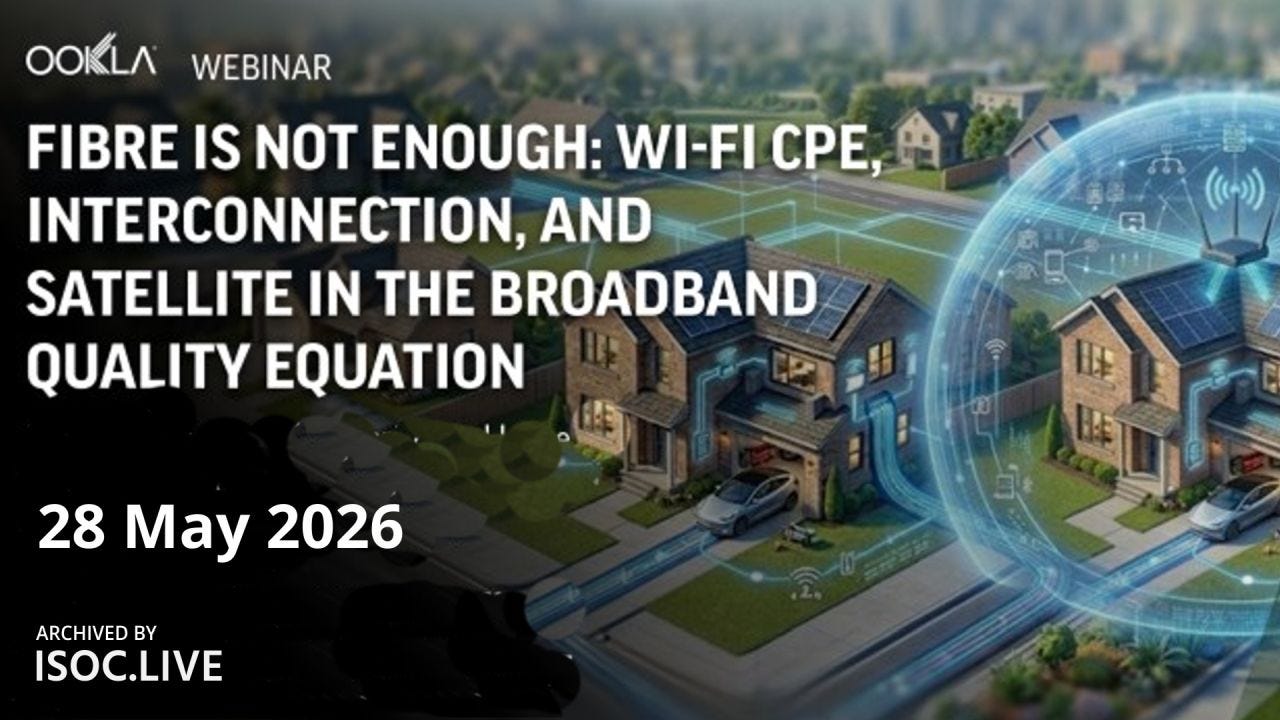
Fibre Is Not Enough: Wi-Fi CPE, Interconnection, and Satellite in the Broadband Quality Equation
Ookla / Fiberevolution – 28 May 2026
VIDEO | AUDIO | RECAP EN / ES / FR | ARCHIVE | PERMALINK
Speakers: Luke Kehoe - Lead Industry Analyst, Ookla; Mark Giles - Director, Industry Research & Analysis, Ookla; Benoit Felten - Managing Director, Fiberevolution
Moderator: Luke Kehoe - Lead Industry Analyst, Ookla
Introduction and Framing the Broadband Quality Debate
Luke Kehoe opened the webinar by explaining that while fibre deployment continues to expand rapidly across Europe, Latin America, North America, APAC, and the Gulf region, fibre access alone no longer serves as a strong competitive differentiator. Multi-gigabit fibre has become increasingly common, shifting attention toward other elements of the broadband ecosystem that influence user experience. He stressed that the webinar title was not intended to diminish the importance of fibre. Rather, fibre should be viewed as the essential foundation upon which other critical components—such as Wi-Fi, customer premises equipment (CPE), network interconnection, peering, and satellite connectivity—must operate effectively to deliver quality broadband experiences.
The Growing Importance of Wi-Fi and In-Home Networks
Drawing on Ookla Speedtest data, Luke highlighted significant differences across European countries in the adoption of modern Wi-Fi technologies, including Wi-Fi 6, 6E, and 7. He noted that some countries with excellent fibre coverage nonetheless underperform in terms of actual user experience because consumers continue using older Wi-Fi standards.
France was presented as a notable example where Internet service providers compete heavily on the quality of their home gateway devices, creating what Luke described as “box wars.” This competition has driven deployment of advanced Wi-Fi equipment and contributed to stronger end-user performance. Ookla’s data showed substantial performance gains when users migrate from older Wi-Fi generations to newer standards, particularly Wi-Fi 7. However, implementation details matter; some Wi-Fi 7 deployments omit the 6 GHz spectrum band, limiting potential performance improvements.
Luke also emphasized that heavy use of the 2.4 GHz band remains a significant factor constraining performance. Markets with higher reliance on 2.4 GHz connections generally show lower proportions of users achieving download speeds above 100 Mbps despite having capable broadband access networks.
Device Limitations and Consumer Experience
Mark Giles expanded the discussion by arguing that fibre rollouts are increasingly exposing bottlenecks elsewhere in the infrastructure stack. While Wi-Fi remains a major factor, end-user devices themselves often limit achievable performance.
He observed that smartphone replacement cycles have lengthened, slowing adoption of newer Wi-Fi capabilities. Many home devices continue to rely on older standards because they require only basic connectivity. Mark illustrated the issue with a personal example: despite having gigabit fibre and Wi-Fi 6E at home, he discovered that an Xbox connected over Wi-Fi 5 was limiting download speeds to approximately 150 Mbps.
Mark also noted that many ISPs remain slow to upgrade customer equipment to Wi-Fi 6E and Wi-Fi 7, even though such upgrades can significantly improve user experience and become a meaningful point of differentiation. Data from AirFiber in Ireland showed that although Wi-Fi 7 adoption is beginning to grow, most customers still rely on Wi-Fi 4 and Wi-Fi 5 equipment, leaving substantial room for improvement.
Multi-Gigabit Fibre and Consumer Perception
Luke questioned whether inadequate Wi-Fi performance may be undermining consumer willingness to upgrade to premium multi-gigabit fibre packages. Benoit Felten responded that market structures vary considerably across Europe, influencing adoption patterns.
He explained that France’s exceptionally high rate of multi-gigabit subscriptions is partly the result of provider strategies rather than direct consumer demand. Some French operators automatically provision customers at the fastest available speed tier, making multi-gigabit service effectively the default option.
Benoit also contrasted France’s highly integrated ISP model, where providers supply comprehensive home networking solutions, with markets where customers purchase and manage their own routers. These differences affect both adoption of advanced technologies and consumers’ willingness to invest in newer equipment.
He further noted that average broadband usage remains extremely low relative to the capacity available on modern fibre networks. Most users consume only a small fraction of the bandwidth available to them, suggesting that fears of widespread network saturation remain largely unfounded. This excess capacity, he argued, demonstrates the long-term value of fibre investments.
Interconnection, Peering, and Latency
The discussion then shifted toward the often-overlooked role of network interconnection and peering.
Luke presented research from Italy showing that fibre users in southern regions experience higher gaming latency than users in northern regions despite having similar access technologies. The difference stems largely from the concentration of interconnection points, data centres, gaming servers, and cloud infrastructure around Milan.
Benoit argued that these findings expose a major policy blind spot. He noted that user experience depends not only on access technology but also on proximity to content and interconnection infrastructure. While policy discussions often focus on broadband deployment, they rarely address geographic distribution of Internet exchange points (IXPs) and interconnection facilities.
He cited Brazil as an example of a country that has actively encouraged a distributed IXP ecosystem, resulting in unusually high per-capita interconnection density. Such policies help improve latency and user experience by reducing the physical distance that traffic must travel.
Benoit criticized provisions under the proposed European Digital Networks Act (DNA), arguing that policymakers appear to assume insufficient cooperation between ecosystem participants despite the existence of millions of peering agreements and relatively few disputes. In his view, introducing unnecessary friction at the interconnection layer risks harming user experience rather than improving it.
AI, Cloud Infrastructure, and Future Network Requirements
Luke and Mark explored how emerging AI applications may increase the importance of latency, jitter, and uplink performance.
Luke observed that countries in the Gulf often achieve higher headline broadband speeds than many European nations, yet may deliver poorer quality of experience because hyperscale cloud infrastructure is less densely distributed. As AI services become increasingly interactive, proximity to cloud resources could become as important as access speed.
Mark noted that most current consumer AI applications are not especially demanding from a network perspective. Many performance limitations arise within data centres and AI platforms themselves rather than broadband networks. However, he argued that future AI use cases may place greater emphasis on latency, jitter, and upstream capacity, prompting operators and researchers to pay closer attention to these metrics.
The Evolution of Starlink and Low Earth Orbit Satellites
The panel examined the growing role of Low Earth Orbit (LEO) satellite systems such as Starlink.
Luke explained that early Starlink deployments often suffered from poor quality of experience because traffic had to traverse highly centralized points of presence. As SpaceX expanded its ground infrastructure and regional traffic breakout capabilities, performance improved dramatically. In some countries, latency dropped by more than 100 milliseconds following deployment of local ground stations and network facilities.
Mark noted that this expansion reflects increasing competition from other LEO initiatives, including Amazon’s Project Kuiper, and highlights how infrastructure placement can substantially influence user experience.
Satellite as a Complement Rather Than a Substitute
A recurring theme throughout the discussion was that satellite should be viewed as a complement to fibre rather than a replacement.
Benoit explained that no major European country currently relies explicitly on satellite within its broadband strategy, though some nations have adopted relatively hands-off regulatory approaches that allow satellite providers to compete freely.
He argued that European policy’s strong preference for fibre has unintentionally weakened the position of fixed wireless access (FWA) solutions. While fibre offers superior performance, FWA can often provide faster and less expensive deployment in rural areas. By prioritizing fibre almost exclusively, policymakers may be creating larger opportunities for satellite operators.
Nevertheless, Benoit expressed skepticism that satellite will become a dominant access technology in fibre-rich markets. Fibre’s economics improve significantly once deployment costs have been recovered, whereas LEO constellations require continuous reinvestment through satellite replacement and launches. Over the long term, this dynamic may allow fibre providers to reduce prices more effectively than satellite operators.
Fibre, FWA, and Rural Connectivity
The conversation highlighted several national examples illustrating how policy choices affect broadband ecosystems.
Mark pointed to Italy’s Eolo as a successful FWA provider serving rural communities. Luke described Ireland’s government-funded rural fibre program as one of the most ambitious in the developed world, delivering XGS-PON connectivity to sparsely populated areas. However, he noted that the program has significantly reduced the role of independent FWA providers.
The panel agreed that policy decisions can profoundly reshape competitive landscapes, often favoring one technology over another regardless of local circumstances.
Resilience and Backup Connectivity
One of the strongest arguments for satellite emerged around network resilience.
Mark described how a major power outage in Spain and Portugal convinced him to purchase a Starlink terminal for backup connectivity. Although power was restored quickly after a subsequent storm, terrestrial Internet service remained unavailable for a week due to damaged infrastructure. Starlink provided continuity during the outage.
Luke observed that similar scenarios have occurred in Ireland, where storms have damaged fibre infrastructure despite extensive broadband deployment. In such cases, LEO satellites provide a valuable secondary connectivity option for households and businesses that depend on reliable Internet access.
Consumer Education and Whole-Home Coverage
The webinar concluded with a discussion about managing consumer expectations regarding broadband performance.
Mark acknowledged that educating users about home networking remains difficult because performance depends on numerous interacting factors, including access technology, Wi-Fi equipment, device capabilities, and home layouts. He suggested that operators increasingly seek to abstract this complexity away from consumers while offering services that guarantee whole-home coverage.
Examples included technician-assisted Wi-Fi optimization services and managed networking solutions that help customers achieve better in-home performance.
Benoit noted that some equipment vendors have promoted “fibre-to-the-room” architectures that extend fibre deeper into homes. While adoption remains limited in Europe, such solutions demonstrate that perfect coverage is achievable, albeit at additional cost.
Both speakers agreed that broadband quality increasingly depends on the interaction of multiple layers within the connectivity ecosystem. As fibre becomes ubiquitous, differentiation will increasingly come from improvements in Wi-Fi, home networking, interconnection, cloud proximity, resilience, and complementary technologies such as satellite connectivity.
RESOURCES
Ookla Research — global connectivity research hub referenced throughout by Luke Kehoe and Mark Giles
Fiberevolution — Benoit Felten’s broadband strategy consultancy
Speedtest — Ookla’s consumer testing application underpinning the webinar’s data
Speedtest Pulse — Ookla’s field-technician Wi-Fi diagnostic device, cited as a whole-home coverage tool
Downdetector — Ookla outage-tracking brand, referenced re: AI platform outages
Digital Networks Act (DNA) — European Commission’s draft telecoms regulation discussed on interconnection and FWA policy
DESI — EU Digital Economy and Society Index tracking multi-gigabit subscription metrics
Starlink — SpaceX LEO satellite service central to the resilience and rural-gap discussion
Eolo — Italian FWA provider cited in the FWA-versus-satellite comparison
Luke Kehoe — host and Lead Industry Analyst at Ookla