

To Be or Not to Be: The Uncertain State of New York AI Regulation (summary)
The RAISE Act takes effect January 1, 2027 - if Washington lets it...
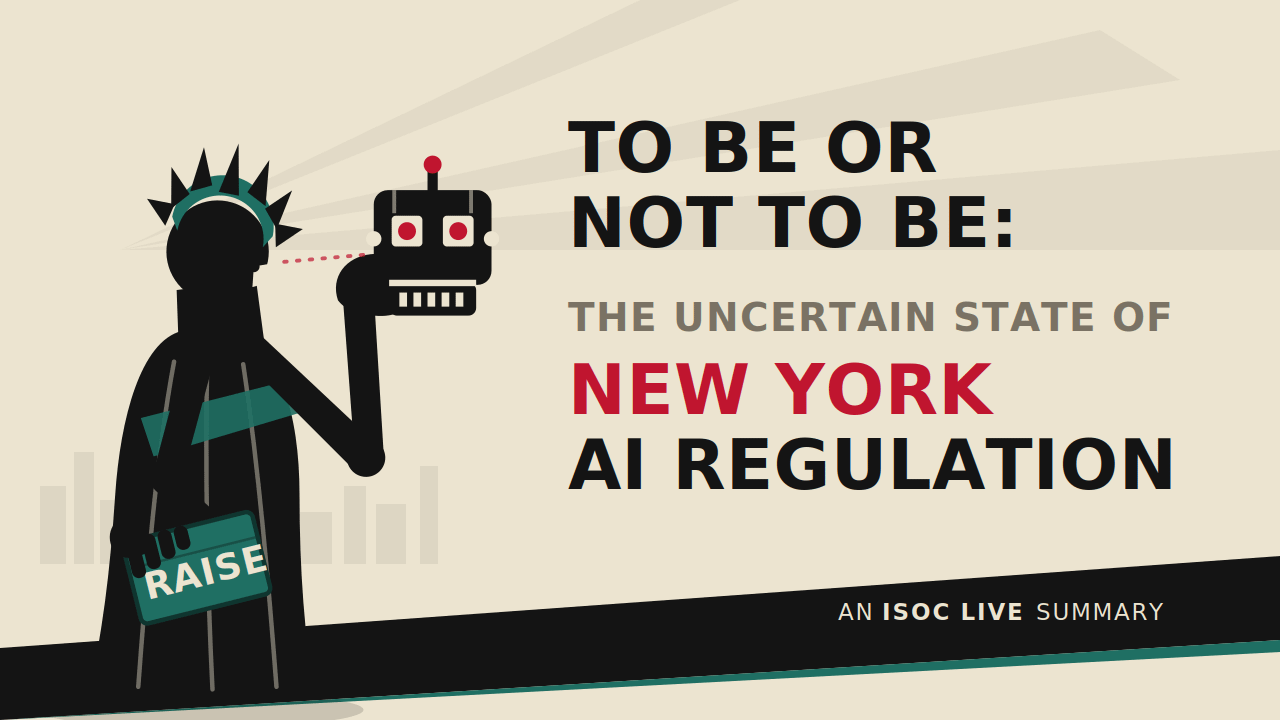
On March 27, 2026, Governor Kathy Hochul signed the final version of the Responsible AI Safety and Education Act, making New York the second US state - after California - to regulate developers of the most powerful “frontier” AI models. The law takes effect January 1, 2027. But the ink was barely dry before the question changed from “what does it require?” to “will it survive?”
The law itself. The RAISE Act is the product of a long, contentious negotiation. The Legislature originally passed it in June 2025, in a version Politico called the furthest-reaching AI bill in the country. Hochul held off for months, signing an initial bill on December 19, 2025 only on the condition that the Assembly pass agreed-upon “chapter amendments” pulling it closer to California’s Transparency in Frontier Artificial Intelligence Act (TFAIA, also known as SB 53). Critics, including the bill’s own sponsors, called the rewrite a gutting. The final, narrowed version Hochul signed on March 27, 2026 - the one summarized in a new Davis Polk client update - is what will actually govern developers.
What it covers. The Act applies to “frontier developers” - companies that develop, deploy, or operate frontier models in New York. A frontier model is one trained using more than 10^26 integer or floating-point operations, the same compute threshold California uses, counting original training plus any subsequent fine-tuning. The heaviest obligations fall on “large frontier developers” - those with gross annual revenue above $500 million, again matching California.
What developers must do. Large frontier developers must write, implement, follow, and conspicuously publish a “frontier AI framework” describing how they handle catastrophic-risk thresholds, mitigations, third-party assessment, model-weight security, incident response, and internal governance. All frontier developers - not just the large ones - must publish a transparency report whenever they deploy a new or substantially modified model, and may not make materially false or misleading statements about catastrophic risk. Large developers must also file a disclosure statement with the New York Department of Financial Services (DFS), renew it every two years, and pay a pro rata share of the Act’s administrative costs.
The headline divergence from California: a 72-hour critical-incident reporting window (down to 24 hours for imminent risk of death or serious injury), versus California’s 15 days. The Act also grants rulemaking authority to a new office within DFS, and empowers the Attorney General to seek civil penalties of up to $1 million for first violations and $3 million for repeats. There is no private right of action.
“Catastrophic risk.” Defined much as California does: a foreseeable, material risk of death or serious injury to more than 50 people, or at least $1 billion in damages, materially caused or enabled by a frontier model - whether through expert-level help building chemical, biological, radiological or nuclear weapons; autonomous conduct that would be a crime if a human did it; or a model evading its developer’s control.
The roadblocks. Here is where May 2026 reframed the story. New York Republicans in Congress, and a pair of House members - Jay Obernolte (R-CA) and Lori Trahan (D-MA) - are working on a bill that would preempt state AI laws governing model development for two years. State lawmakers, including RAISE sponsors Andrew Gounardes and Alex Bores, have reacted with alarm; Bores, now running for Jerry Nadler’s House seat, has been the target of millions in attack ads from the AI-industry super PAC Leading the Future. The original RAISE Act was signed just days after President Trump’s December 2025 executive order directing the Justice Department to challenge state AI laws.
And the twist. On May 21, 2026, the White House abruptly postponed an executive order Trump had been expected to sign that very afternoon - invitations to tech executives had already gone out. The order would have established a voluntary review process for AI models before release, giving federal agencies up to 90 days for security review, with OpenAI and Anthropic among the firms negotiating with the administration. Trump said he delayed it because he didn’t like certain aspects of it and worried it could have been a blocker to the US lead over China. As technologist Lauren Weinstein framed it, an order to require inspection of AI models was on the desk - and Big Tech talked the President out of it at the last minute. The irony is sharp: a federal government that wants to preempt state safety rules also just walked away from creating a federal one.
Why it matters. For now, the RAISE Act stands - and on January 1, 2027, large developers will owe New York published frameworks, transparency reports, disclosure filings, and 72-hour incident reports. Whether they actually will depends less on Albany than on Washington: a two-year congressional preemption bill, a litigation-minded executive order, and a White House that just demonstrated it can be talked out of oversight overnight. New York and California have built the floor. The fight now is over whether anyone is allowed to stand on it.
RESOURCES
Davis Polk client update - the legal analysis that prompted this summary
Governor Hochul’s signing announcement - the official December 2025 statement
New York Department of Financial Services - the agency that will administer and enforce the Act
RAISE Act (S6953-B / A6453-B) - the bill text and legislative history
State Senator Andrew Gounardes - Senate sponsor of the RAISE Act
Assemblymember Alex Bores - Assembly sponsor, now a candidate for NY-12
California’s TFAIA (SB 53) - the Transparency in Frontier Artificial Intelligence Act the RAISE Act was aligned to
Executive Order 14365 - Trump’s December 2025 order targeting state AI laws
CNN: White House postpones AI executive order - the May 2026 reversal on a federal model-review process
Lauren Weinstein - technologist and privacy advocate, on the shelved inspection order