

Toward Undersea Cable Resilience: The Case for Global Collaboration
An ISOC LIVE Summary
Author: Charles Mok - Stanford University
Charles Mok’s essay in the Texas National Security Review argues that the resilience of the world’s submarine cable networks — carrying up to 99 percent of intercontinental data — has become inseparable from economic and national security, and that democracies must act together to protect it against escalating gray-zone sabotage. Mok’s framing is pointed: this is not a diffuse “global responsibility” problem but a challenge posed chiefly by China and Russia, requiring coordination among “like-minded” free countries.
The piece opens on a pattern of recent incidents concentrated in geopolitically sensitive chokepoints. In the first two months of 2025, four cable disruptions hit Taiwan, including connections to the outlying Matsu and Penghu islands. The Baltic Sea has seen a steep rise in damage from vessels operating in the region, and in 2024 the Houthis allegedly attacked at least three Red Sea cables. Mok notes that most — though not all — of the vessels found causing damage in the Baltic and around Taiwan are owned or registered in Russia or China.
A central problem is repair and legal accountability. Under UNCLOS, a coastal state has enforcement power only within its 12-nautical-mile territorial sea; once damage occurs in international waters, jurisdiction falls to the flag state or the perpetrator’s country of citizenship, leaving cable owners little recourse. Repair itself is slow and thinly resourced — only a handful of companies lay and fix these cables, using an aging fleet of ships often more than twenty or thirty years old, so repairs can take weeks or months.
Mok documents gray-zone aggression turning more overt: the Yi Peng 3, which dragged its anchor for over 180 nautical miles to sever the C-Lion 1 cable in November 2024 (investigated only under Chinese oversight, as the incident occurred in international waters); and the Togo-registered Hong Tai 58, whose captain — identified only as “Wang” — was sentenced in Taiwan to three years for cutting the TPKM3 cable near Penghu. He also cites reporting on a Chinese deep-sea cable cutter and suspected Russian seabed sensors in UK waters, while noting analysts’ skepticism about how much is genuine capability versus “theater” meant to sow unease.
The essay ties this directly to the AI race. Hyperscalers — Google, Meta (via Project Waterworth), Microsoft, and Amazon — have overtaken telecoms as the largest cable investors, with OpenAI, Nvidia, and SoftBank likely to follow. Because the data centers and models underpinning AI depend on the fiber that links continents, Mok argues the future of AI security depends on maritime and undersea security.
He sets out five steps for a coordinated response: invest in hardened cable technology and AI-assisted monitoring (citing the UK’s Nordic Warden system, now shared across NATO/JEF states); build redundancy through more cables and landing sites, aided by public-private models like Australia’s AIFFP and the EU’s 2024 recommendation on secure submarine infrastructure; exploit route-diversity realignment (new trans-Pacific projects skirting Hong Kong and the South China Sea via Guam, the Philippines, and Indonesia — e.g., the E2A and Far North Fiber systems); expand regional repair capacity by leveraging shipbuilders like Japan and South Korea; and coordinate globally on law and enforcement, including modernizing frameworks such as UNCLOS.
On policy, Mok credits some US progress while insisting it is insufficient. In early August 2025 the FCC finalized new cable rules for the first time in over two decades, applying a presumption of denial to foreign-adversary-controlled applicants and restricting equipment and leasing tied to China, Russia, and Iran — aiming to exclude Huawei and HMN Technologies (the former Huawei Marine Networks, now the world’s fourth-largest cable builder). But these rules reach only US-connected systems. Multilateral efforts — the 2023 G7 digital ministers’ declaration, the Quad’s September 2024 joint statement, NATO Baltic patrols, and the 2015 Canada–Taiwan dark-vessel-detection agreement — have acknowledged the threat, yet concrete implementation lags; the 2025 G7 summit in Canada made no meaningful progress. Mok concludes that because US connectivity depends on cable safety in Europe and East Asia alike, the United States cannot sit out global cooperation: true resilience can only be achieved together.
RESOURCES
Toward Undersea Cable Resilience: The Case for Global Collaboration — the source essay, Texas National Security Review (Jun 2026)
Charles Mok — author; research scholar, Stanford Global Digital Policy Incubator, and ISOC Board of Trustees
FCC, Submarine Cable Buildout & Security Order — first major rules revision since 2001, adopted Aug 2025
ISOC, Enhancing the Resilience of Submarine Internet Infrastructure — policy brief (Dec 2025)
ITU International Advisory Body for Submarine Cable Resilience — multilateral coordination forum
International Cable Protection Committee — industry body for cable protection and best practice
Atlantic Council, on UNCLOS gaps in cable protection — legal-accountability analysis cited in the piece
The Verge, “The Cloud Under the Sea” — on the thin, aging repair-ship industry
Digitally Yours — Mok’s Substack, with ongoing writing on undersea cable resilience
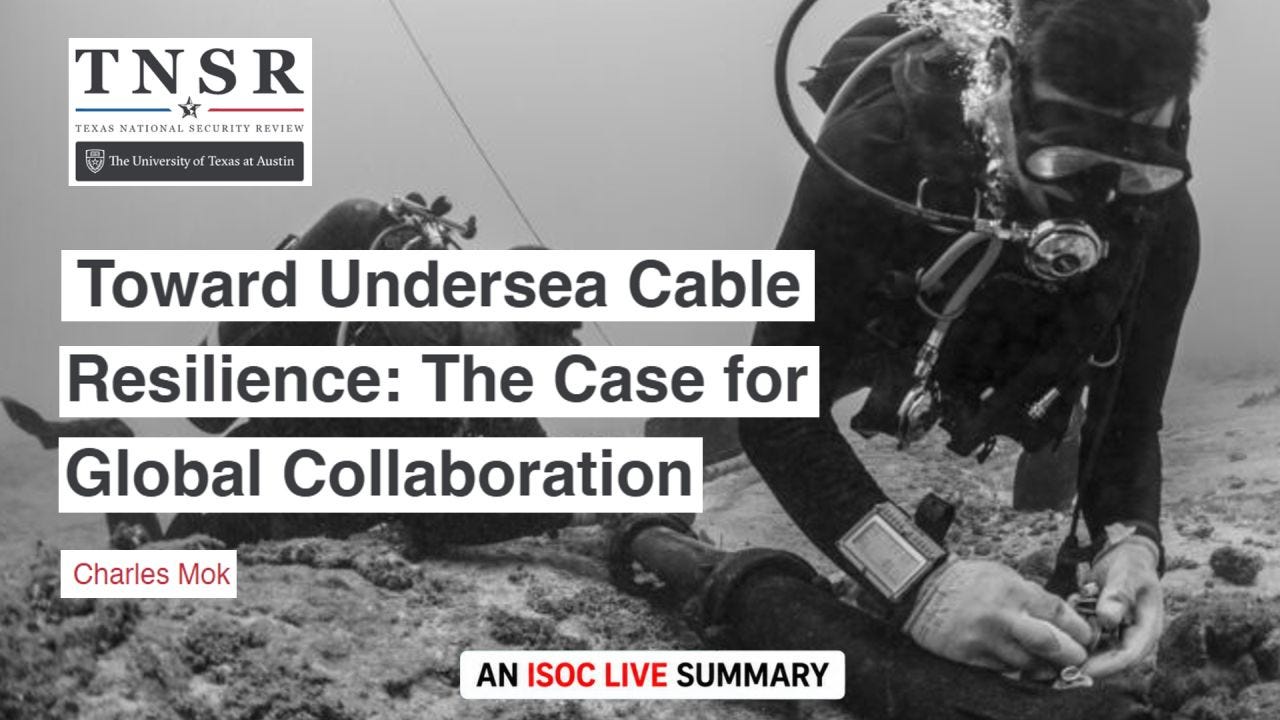
Photo credit: Chief Mass Communication Specialist Charles E. White — U.S. Navy Seabee diver (UCT-2) performing undersea cable maintenance off Kauai, Hawaii, 2016.
Thanks!