

Community-Centered Connectivity in Rhino Camp Refugee Settlement, Uganda
AN ISOC LIVE SUMMARY
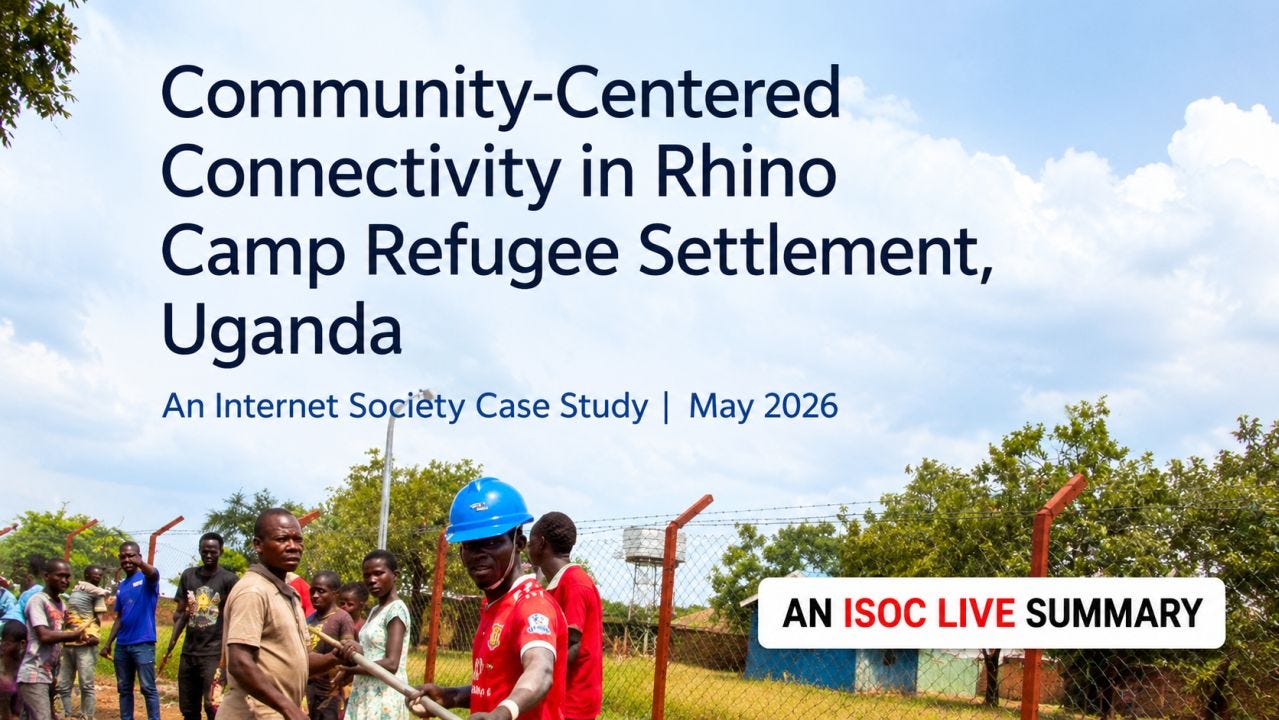
Community-Centered Connectivity in Rhino Camp Refugee Settlement, Uganda
Rhino Camp Refugee Settlement, Uganda | Internet Society Case Study | May 2026
This Internet Society case study documents a community-centered connectivity initiative implemented between 2025 and early 2026 in Rhino Camp Refugee Settlement, Uganda, through a partnership with the Community Empowerment & Transformation Agency (CETA), Hello World, and the Research and Education Network for Uganda (RENU). The initiative focused on combining Internet infrastructure deployment with long-term local capacity building, governance, and sustainability.
Context and Local Challenges
Rhino Camp Refugee Settlement consists of eight zones housing approximately 192,000 refugees alongside a 158,271-person host community. The region faces limited grid power, expensive connectivity, weak mobile coverage, and uneven digital access. Mobile Internet is often the only available option, but poor quality and high costs limit access to education, livelihoods, public services, and information. Humanitarian funding pressures also highlighted the need for locally managed and financially sustainable connectivity solutions.
The initiative responded by prioritizing skills development and institutional capacity alongside infrastructure deployment. It leveraged Internet Society curricula, local leadership through CETA, and technical collaboration with Hello World and RENU to create community-operated connectivity systems that could evolve independently over time.
Internet Society Training and Capacity Building
A major component of the initiative was the Internet Society’s Designing and Deploying Computer Networks (DDCN) training program and related community network courses. CETA acted as the local training delivery partner, organizing facilitation, mentoring, and participant outreach. A total of 135 refugee and host-community participants received practical instruction in networking fundamentals, LAN and wireless design, routing, power systems, Internet standards, and troubleshooting.
The project emphasized a training-of-trainers model designed to embed expertise locally. Six technically capable participants were prepared to mentor peers and support future training cycles. Graduates also participated directly in network deployment and operational management with Hello World and RENU, while peer-support groups were formed to sustain learning beyond formal coursework.
Embedded Learning During Infrastructure Deployment
Training extended beyond classrooms into practical field deployment. During construction of the community hubs, Hello World integrated engineering training directly into the build process. Altogether, 444 community members received hands-on training during site deployment activities.
Participants learned to install and maintain solar systems, wire and mount networking equipment, configure routers and mesh nodes, and apply maintenance and troubleshooting procedures. The report notes that this “learning by doing” model strengthened confidence and normalized refugee and youth participation in technical leadership roles.
Community-Owned Connectivity Infrastructure
The Internet Society funded deployment of two community-owned digital hubs, known as “Hello Hubs,” in Rhino Camp’s Siripi and Ofua zones. Hello World led deployment activities, while CETA coordinated local operations and stewardship. Hello World estimates the project has connected approximately 7,900 users so far through the hubs and surrounding connectivity extensions.
The deployment process included collaborative site selection with community leaders, settlement authorities, and UNHCR counterparts. Infrastructure included solar-powered systems adapted to off-grid conditions, mobile backhaul connectivity, and a mesh networking proof-of-concept implemented with RENU. The report emphasizes that connectivity was intentionally extended beyond the hubs themselves into nearby markets, schools, and community spaces.
Governance, Ownership, and Sustainability
The project institutionalized community ownership from the outset. Communities elected hub management committees responsible for governance, accountability, safeguarding, and sustainability. Locally agreed rules defined access and conflict-resolution mechanisms, while committees introduced affordable service models for Internet access and device charging.
The report contrasts this model with the existing mobile connectivity environment, where weak and inconsistent services average 105 Mbps of limited data at a cost of UGX 2,500–4,000 per gigabyte for 24-hour access. Streaming or participating in online meetings could exhaust a daily data package within an hour, making commercial mobile services prohibitively expensive for most residents.
Partnership and Accompaniment Model
The initiative relied on complementary roles among the partner organizations:
The Internet Society provided curricula, strategic guidance, and learning oversight.
CETA served as the local lead organization and training partner.
Hello World handled deployment, embedded engineering training, and ongoing technical support.
RENU contributed mesh networking expertise and future-ready architecture design.
The report also highlights an “accompaniment” approach centered on sustained engagement with communities over time. This included regular problem-solving sessions, remote monitoring of solar and network systems, and gradual transfer of operational responsibility as local confidence increased.
Impact and Outcomes
The initiative produced several measurable outcomes:
Technical and operational outcomes included:
Two operational community-owned digital hubs serving over 4,500 refugees and host-community members directly (within Hello World’s broader estimate of approximately 7,900 users connected so far).
Six trained local technicians capable of independently resolving routine network and solar issues.
A modular and scalable network architecture suitable for future replication.
Social and economic impacts included:
Improved affordable Internet access for education, communication, and livelihoods.
Increased participation and confidence among women and youth in technical roles.
Expanded connectivity to markets and small businesses.
Institutionally, the project strengthened CETA’s role as a local digital inclusion and training organization capable of delivering Internet Society courses and managing infrastructure. The organization plans to train an additional 450 people during 2026.
Community Feedback and Replicability
The report includes testimony from Justin Lisisa Lobela, 28, a refugee youth representative originally from the Democratic Republic of Congo, who described how Internet access reduced theft by keeping youth engaged in positive activities—enabling communication with family, online learning, scholarship searches, and access to educational resources. After participating in early training courses, he now trains others in online trust and safety.
The report concludes that refugee-led connectivity models are viable when infrastructure deployment is inseparable from local skills transfer, governance, and financial stewardship. It positions Rhino Camp as a scalable blueprint for UNHCR, the Internet Society, and partners seeking sustainable digital inclusion models in displaced and refugee communities.
RESOURCES
Community-Centered Connectivity in Rhino Camp Refugee Settlement, Uganda — the full Internet Society case study (May 2026)
From Email to Case Study — ISOC’s one-year reflection on how the partnership began with an email from CETA’s Samuel Lasu
From Refugee to Digital Leader — profile of DDCN graduate and trainer Justin Lisisa Lobela
Learning to Build and Use the Internet in Rhino Refugee Camp — Dec 2025 field report on the first DDCN cohorts and hub groundbreaking
Bridging the Digital Divide: 135 Graduate — ISOC Uganda Chapter on the October 2025 DDCN graduation, organized by CETA
Designing and Deploying Computer Networks (DDCN) — the Internet Society training course at the core of the initiative
Hello World — the UK charity that deployed the solar-powered “Hello Hubs”
Research and Education Network for Uganda (RENU) — implemented the mesh-network proof-of-concept
Internet Society Foundation — funded Hello World and RENU as grantees
UNHCR — the UN Refugee Agency, a site-selection counterpart and target audience for the replication blueprint