

Beyond the Hype – Building a Durable Career in a Changing Technology Industry
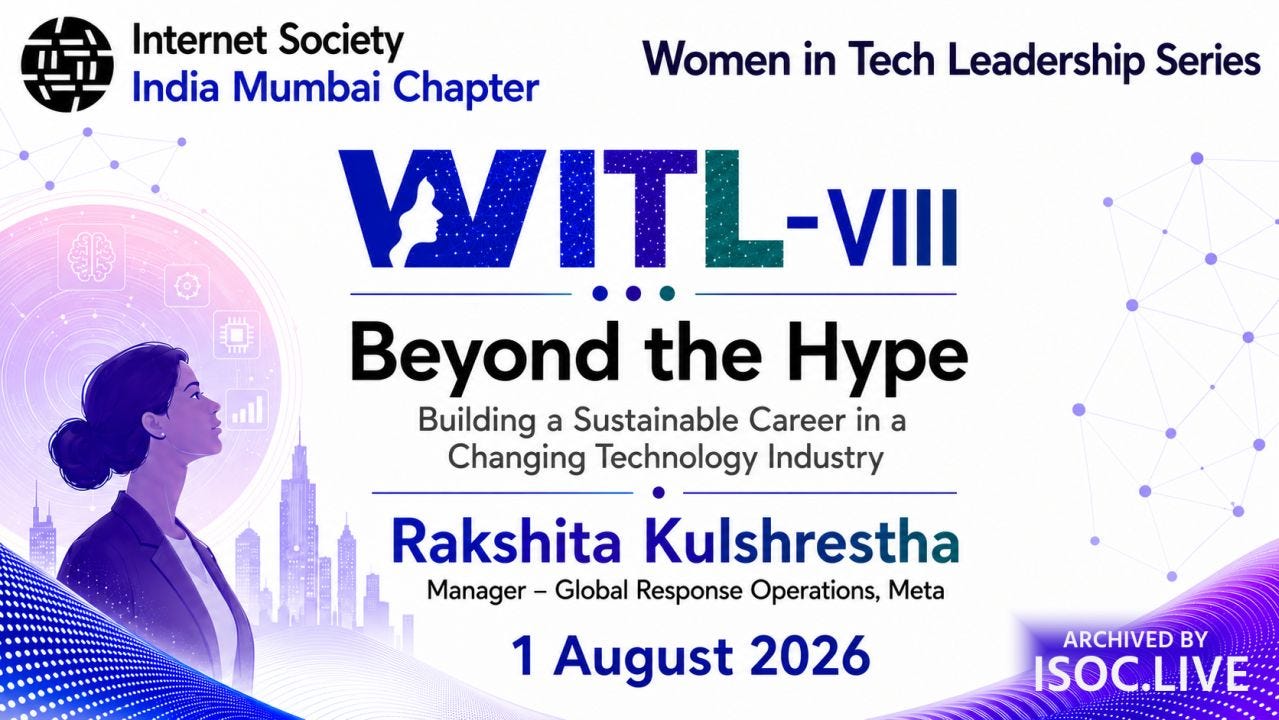
Internet Society India, Mumbai Chapter - Women in tech Leadership VIII - 1 August, 2026
VIDEO | AUDIO | RECAP EN / ES / FR | ARCHIVE | PERMALINK
Speaker: Rakshita Kulshrestha - Manager, Global Response Operations, Meta
Moderator: Vatsla Srivastava - President, Internet Society India Mumbai Chapter
Opening and introduction
Vatsla Srivastava framed the session around a central concern for professionals at every career stage: how to build a sustainable career while job descriptions, organizational structures, tools, and even the nature of work are changing. Rather than relying on a single qualification, employer, or technical skill, the discussion would examine the roles of continued learning, adaptability, networks, and intentional career choices.
She introduced the Internet Society as a global, community-driven nonprofit working for an open, globally connected, secure, and trustworthy Internet. Its network brings together technologists, policymakers, researchers, civil society practitioners, students, and community leaders concerned with how the Internet is built, governed, and used.
Srivastava described the Internet Society India Mumbai Chapter as an all-women-led chapter and an accredited ICANN At-Large Structure. Its work focuses on Internet governance, digital policy, emerging technologies, capacity building, and representing the interests of end users. It seeks to make technology discussions accessible to people outside conventional technical and institutional spaces.
The Women in Technology Leadership series, now in its eighth edition, was created to give women more than generic inspiration or polished success stories. It examines how careers are actually built, what skills matter, which pathways exist, how networks and professional authority develop, and how people navigate uncertainty. Its understanding of technology leadership includes strategy, operations, policy, law, communications, governance, entrepreneurship, and community building alongside engineering.
Introducing Rakshita Kulshrestha, Srivastava noted that her career had moved through sales, strategy, operations, trust and safety, and global response. She had also left a large technology company to work in a startup before returning, giving her experience of different organizational environments and a non-linear career path.
Entering an emerging field
Rakshita Kulshrestha joined Facebook through campus recruitment in 2011, immediately after graduating from Lady Shri Ram College at the University of Delhi. She admitted that she did not fully understand what she was applying for at the time. She entered a function then called User Operations, before “trust and safety” had become an established professional field.
Facebook had approximately 2,100 employees, compared with about 75,000 at the time of the session. The company was considering how to scale from millions of users to one billion while digital advertising and marketing were still evolving. Users and advertisers continually found new ways to use the platform, creating unfamiliar operational and policy problems. Teams regularly had to develop solutions and write policies where no precedents existed.
Trust and safety was not yet widely recognized as a distinct function, especially outside the largest technology companies. From roughly 2015 onward, it became more prominent and developed its own courses, certifications, events, professional community, and career pathways. Kulshrestha regarded the opportunity to participate in that evolution as one of the most significant parts of her career.
She said the industry had now reached another inflection point with AI. Questions that trust and safety practitioners had spent 10 to 15 years understanding must be reconsidered for AI products and environments. Although this creates uncertainty, it also opens space to explore and solve problems that have not previously existed.
Transferable skills and lateral growth
Rakshita Kulshrestha spent approximately six and a half to seven years in trust and safety, but worked across varied areas including hate speech, impersonation, risk mitigation, regulatory concerns, and responses to public-relations crises. Her underlying strengths were in data and operations, particularly understanding what was happening at scale and developing scalable solutions.
After spending years in one function, she began to fear that it defined the limits of what she could do. She could either continue into a managerial leadership path or move into a different part of the business. She chose to move into sales because she wanted to understand how the company made money and how other parts of the organization operated.
That transition required both learning and unlearning. Familiar assumptions and practices could not simply be carried into a fundamentally different function. Kulshrestha stressed that unlearning is important whenever someone changes roles, teams, managers, or organizational environments because it creates room for new approaches.
Curiosity and problem-solving were the most durable abilities she carried across roles. She adopted the principle that a problem should not automatically be treated as somebody else’s responsibility: if she could not solve it herself, she could identify the people capable of helping. This mindset allowed her to develop unfamiliar skills and become effective in new areas.
Sales required her to begin again as a novice, including learning unfamiliar metrics and practices. Her experience demonstrated that career growth need not be exclusively vertical. Lateral movement can provide a broader understanding of an organization and make someone a more versatile problem-solver.
Kulshrestha also urged women to identify, name, and confidently communicate their strengths. Professional identity is not defined by one role held for several years; it also consists of problem-solving ability, relationships, reputation, and transferable capabilities.
Careers beyond engineering and product development
Rakshita Kulshrestha emphasized that a technology company with tens of thousands of employees necessarily contains many roles beyond its most visible engineering, product, and sales positions.
She recommended beginning with the kinds of problems a person enjoys solving:
Commercial problems can lead to sales, business development, marketing science, or digital marketing.
Investigative or policy-related problems can lead to risk management or trust and safety.
Work involving governments or regulation can lead to public policy, communications, or legal roles.
People who enjoy building products may pursue engineering or related technical work.
Rather than choosing a field solely by title, candidates should identify several companies of interest and review their career pages regularly. Reading job descriptions reveals which functions exist, what skills employers seek, and how an applicant’s interests and experience might fit. Technology companies recruit people from journalism, law, engineering, policy, communications, and many other backgrounds.
Kulshrestha cautioned that AI is changing all these functions, so career planning must also consider how roles may evolve over the next two to five years.
Expertise and technological fluency in the AI era
Rakshita Kulshrestha acknowledged the anxiety created by layoffs, leaner teams, restructuring, rapidly changing tools, and redesigned jobs. AI now allows people without a technical background to perform limited engineering, product-management, or data-analysis tasks. However, she did not believe this eliminated the need for specialists.
AI may allow someone to work at a surface level, but deeper work still requires domain knowledge. Experts are needed to troubleshoot, evaluate whether outputs are correct, understand limitations, and use the technology appropriately. Professionals should therefore protect and deepen their existing expertise rather than abandon it to pursue every new AI capability.
Alongside expertise, they should develop technological fluency. A policy specialist, for example, does not need to become an engineer, but should understand how relevant products function, how they are evolving, what implications they create, and how to communicate effectively with technical teams. Product, policy, operations, and other disciplines are increasingly interconnected.
Her central recommendation was to keep domain expertise close while building enough technical understanding to work across professional boundaries.
Reputation and sustainable networks
Kulshrestha identified professional relationships and reputation as assets that remain valuable regardless of technological or organizational changes. People remember whether a colleague was reliable, collaborative, helpful, and capable of solving problems.
As an introvert, she did not find large networking events especially effective for herself. She preferred a smaller network of people who knew her work and could credibly vouch for her over hundreds of superficial online connections. Different methods work for different people, but the chosen approach must be sustainable rather than a one-time exercise.
A durable network begins with doing good work. Reliability, commitment, collaboration, and useful contributions give professional contacts a reason to maintain and recommend a relationship.
She advised against contacting a stranger with only a résumé and a general request for a job. Applicants should first identify the particular role, location, requirements, and connection to the recipient’s work. A request should be specific about the information or assistance sought. Alternatively, someone can approach a professional from genuine curiosity and ask to understand their field and the opportunities within it.
People can begin with peers, current and former colleagues, alumni, classmates, friends, relatives, or friends of friends. Thoughtful preparation and precise questions make others more willing to help. Not every conversation will produce an opportunity: perhaps only 10 to 20 contacts out of 100 will lead somewhere, but the remaining conversations can still provide information and experience.
Access barriers and networking for women
During the Q&A, Utsarjana Mutsuddi observed that sociocultural capital is unevenly distributed in India. Talented women may lack professional networks or face barriers to accessing the connections available within their families and communities.
Rakshita Kulshrestha acknowledged that networking can be uncomfortable and inaccessible, with different people facing different constraints. Nevertheless, professionals must learn to present themselves, explain what they do, and identify the value they offer. She noted that it took her years to articulate her own value, and that conversations with others can help a person recognize it.
There is no single forum that resolves access problems. Some people may prefer events, while others may find outreach to strangers on LinkedIn more comfortable than approaching their immediate network. Finding an effective method requires experimentation.
She also advised developing resilience around rejection. Many approaches will not receive a response or produce the desired result. Treating every failure personally makes the process harder; learning from it and proceeding to the next contact is essential.
Taking calculated career risks
Rakshita Kulshrestha said the appropriate time to take a career risk depends on a person’s life stage, financial position, responsibilities, and professional foundation. A stronger moment for risk-taking comes after someone has developed expertise that can continue to carry them through a transition.
A mentor once asked her whether she was running away from a situation or moving toward something. That question became an important test for career decisions. Leaving only to escape a difficult workplace may lead to another unsuitable position because the person has not identified what they actually want.
Before making a move, professionals should consider why they are taking the risk, what the destination offers, and which skills or experiences they expect to gain. Kulshrestha left Meta shortly after being promoted, while happy with her team and performing well. She moved because she wanted to experience a small startup, and she selected one operating in a field where she already had relevant expertise. It was therefore a calculated rather than impulsive risk.
She was transparent with her managers and colleagues about why she was leaving and maintained her commitment through her final day. Her reputation and relationships remained intact. Later, the same team approached her about returning to an open role. She advised people to leave organizations responsibly, keep their networks informed, and preserve trust even while making a significant change.
Specialist or generalist?
Vinayak Bharadwaz, a computer science undergraduate interested in public policy and community building, asked whether a new entrant should become a specialist or generalist.
Rakshita Kulshrestha advised early-career professionals to begin by choosing one or perhaps two lanes. Initial specialization provides a foundation of expertise and a clear entry point into the workforce. Working with other teams will then expose them to adjacent functions and help them decide whether they prefer their own work or another pathway.
A first choice does not have to be permanent. Someone may decide after a year that the field is not right for them. Kulshrestha described herself as a generalist whose varied experience allows her to take a broad view of problems, but she still recommended that new entrants first establish competence in a defined area before widening their scope.
AI and trust and safety
Responding to a question from Prateek about Meta’s trust and safety work, Rakshita Kulshrestha clarified that she was speaking in a personal capacity rather than as a Meta spokesperson.
She said AI was helping teams address some straightforward problems more quickly and efficiently, leaving more time for complex issues. Trust and safety continually changes because teams respond to real-world events including wars, elections, and mass shootings. Even events occurring within the same month may involve different uses of social platforms and require distinct response, communications, and resolution strategies.
From her perspective, AI was not simply adding challenges; it was also reducing workload in some areas and expanding the organization’s capacity to address difficult problems.
Emerging technology-policy gaps
Pramit, a policy professional and former LAMP Fellow, asked which unaddressed technology-policy gaps might create future opportunities.
Rakshita Kulshrestha said it was too early to confidently predict the roles or policy needs that would emerge. She recommended closely observing how people use AI tools and social platforms, especially forms of misuse that current policies may not cover.
AI can improve efficiency, but it can also facilitate wrongdoing. In some cases, the policy problem may be similar whether harmful content was produced with AI or through older methods. Trust and safety in relation to AI remains a vast, incompletely understood challenge. Researchers and policy professionals should follow patterns of product use and misuse to identify where rules, safeguards, and professional roles may need to develop.
Moving beyond degree requirements
Bhuvna Arora, an early-career business researcher with undergraduate and master’s degrees in sociology, asked how to move between fields when employers insist on qualifications such as a BTech or MBA.
Rakshita Kulshrestha said some companies and career tracks remain strongly focused on formal qualifications, while others place greater weight on demonstrated ability and previous work. Applicants must identify which employers are open to candidates with different educational backgrounds.
Kulshrestha had considered pursuing a master’s degree herself but decided that the return on investment would be limited. Other colleagues had pursued advanced degrees because they wanted to make more substantial changes in their careers. The decision depends on the intended pathway rather than a universal requirement.
For candidates who do not want another degree, effective professional branding is crucial. They should avoid presenting themselves primarily in terms of what they lack. Instead, they should connect specific projects and demonstrated skills to the requirements of the target role, while acknowledging which technical elements they can learn after joining.
Kulshrestha used her own transition from trust and safety to sales as an example. She could not compete on previous sales experience, so she had to identify and communicate the capabilities from trust and safety that would transfer to the new function.
Communications professionals entering technology
Archi Raj, an early-career communications professional, asked about AI-based applicant screening and entering technology companies from a non-linear career path.
Rakshita Kulshrestha did not claim expertise in navigating automated screening systems. On the broader transition, she again recommended starting with the problems the candidate wants to solve. A communications professional might continue solving communications problems, move toward policy, or pursue business development based on interests and relevant experience.
Because candidates cannot meaningfully apply to every kind of technology role, they should research company career pages, study unfamiliar job categories, and use LinkedIn to identify people already doing that work. This can reveal positions they did not know existed and clarify the skills and pathways associated with them. Many people working in technology companies perform non-technical roles and entered from varied professional backgrounds.
Closing
Dr. Adeeti Pareek thanked Kulshrestha for emphasizing unlearning, curiosity, transferable identity, domain expertise, technological fluency, networks, and calculated risk-taking. She also thanked Srivastava, the chapter leadership, core team, advisory members, researchers, designers, documenters, and participants.
Vatsla Srivastava invited first-time attendees to stay connected with the Internet Society India Mumbai Chapter and thanked participants for their questions. She closed by reiterating the chapter’s intention to sustain an accessible community around technology, careers, and Internet governance.
RESOURCES
Internet Society — global nonprofit for an open, secure, trustworthy Internet
Internet Society India Mumbai Chapter — the all-women-led chapter hosting WITL
ISOC Chapters — the 120+ chapter network Srivastava described
ICANN At-Large — the At-Large Structure the chapter is accredited under
ISOC Live: ISOC Mumbai archive — past WITL sessions and recordings
Meta Careers — the job portal Kulshrestha advised checking weekly
Meta Community Standards — the policy layer behind the trust and safety work discussed
Trust & Safety Professional Association — the certifications and events that emerged as the field matured
Lady Shri Ram College, University of Delhi — where Kulshrestha was campus-recruited in 2011
LAMP Fellowship, PRS Legislative Research — the policy fellowship Pramit cited