

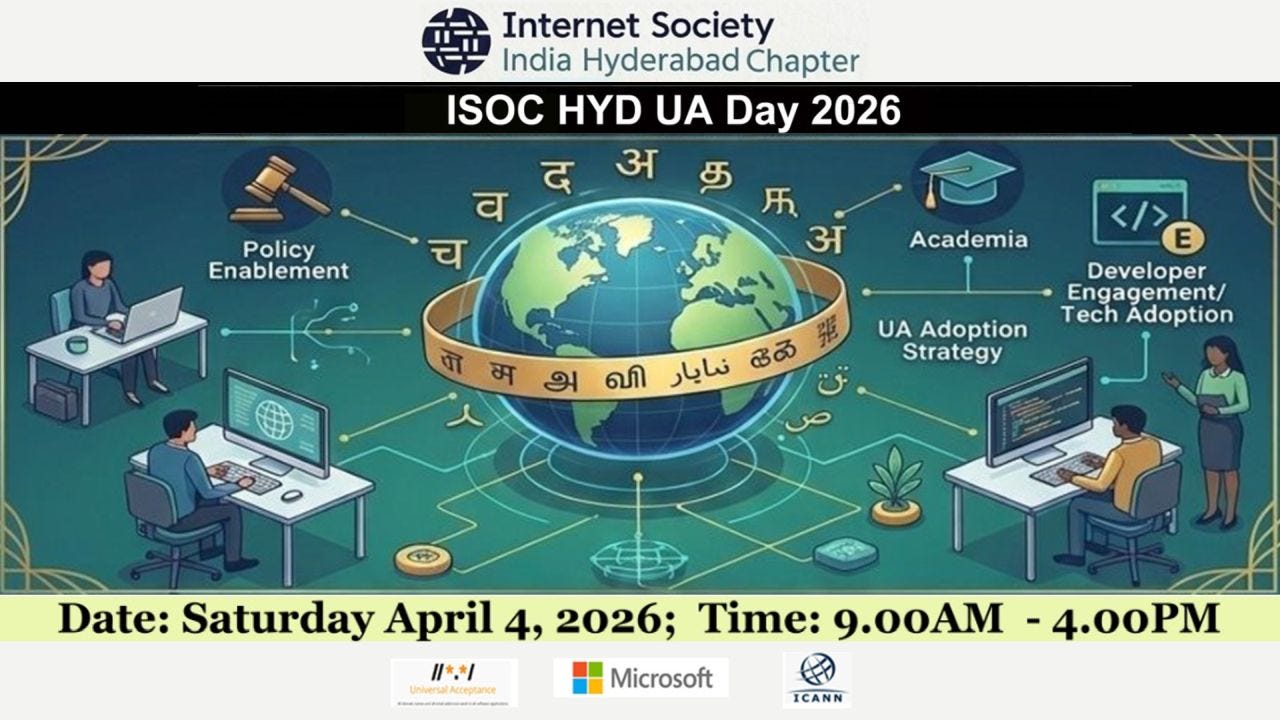
ISOC Hyderabad Universal Acceptance Day 2026
Microsoft Campus, Gachibowli, Hyderabad - 4 April 2026
FULL REPORT | RECAP EN / ES / FR | ARCHIVE | PERMALINK
Speakers/Participants: K Mohan Raidu; Jayesh Ranjan; Vijay Mamtani; Sarmad Hussain; Amitab Singhal; Maaly Hazza; Seshu Venkata; Satish Babu; Kiran Chandra Yarlagadda; Rajeev Ranjan Kumar; Dr. Uday Desai; Dr. Salman Abdul Moiz
Moderator(s): Bala Prasad Peddigari; Manish Gupta
Opening & Context
The Internet Society India Hyderabad Chapter hosted a hybrid Universal Acceptance (UA) Day 2026 event, supported by ICANN, bringing together government, industry, academia, and civil society stakeholders to advance multilingual Internet adoption.
The event opened with a symbolic plant-watering ceremony emphasizing growth, collaboration, and shared responsibility. This set the tone for a day focused on inclusive digital transformation and grassroots engagement in Universal Acceptance.
K Mohan Raidu – ISOC Hyderabad
K Mohan Raidu highlighted the chapter’s leadership in promoting UA, DNSSEC, encryption, and Internet governance since 2020.
Emphasized multilingual Internet adoption through university outreach, faculty training, and curriculum integration
Noted that while IDNs and multilingual email systems are technically ready, adoption gaps persist due to lack of system support
Positioned the event as India’s only UA-focused gathering of the year
Framed the 2026s as a “decade of action” requiring coordinated efforts across government, industry, and academia
His remarks underscored India’s potential to lead globally in building an inclusive, multilingual Internet ecosystem.
Jayesh Ranjan – Government of Telangana
Jayesh Ranjan expanded the discussion beyond connectivity to the broader dimensions of the digital divide:
Lack of devices, language barriers, and social constraints—especially in rural areas
Limited smartphone access affecting women and students
Weak linkage between education and employability, leading to skill gaps
He stressed that technology adoption accelerates when it solves real-world problems, citing practical examples like agricultural apps.
His call to action focused on leveraging AI and emerging technologies to address grassroots challenges through cross-sector collaboration.
Vijay Mamtani – Microsoft
Vijay Mamtani framed UA within the broader context of rapid technological change and AI:
Highlighted that only about 19% of the global population speaks English, making multilingual access essential
Identified a widening AI adoption gap between Global North and South
Outlined Microsoft’s investments in India, including AI infrastructure, data centers, and skilling initiatives
He emphasized opportunities in MSMEs, women’s empowerment, and the gig economy, urging innovators to build inclusive, AI-driven solutions.
Amitab Singhal – ICANN
Amitab Singhal positioned Universal Acceptance as critical for onboarding the next billion Internet users:
UA ensures all domain names and email addresses function across scripts and languages
Persistent barriers stem from legacy systems, low prioritization, and lack of awareness
Called for coordinated action across governments, developers, and industry
His remarks reinforced UA as foundational to a truly global Internet.
Maaly Hazza – UNESCO
Maaly Hazza emphasized the cultural and developmental dimensions of UA:
Language remains a major barrier despite increased connectivity
Digital content is still dominated by a few global languages
UNESCO initiatives focus on multilingualism, digital inclusion, media literacy, and integration into public systems
She stressed that preserving linguistic diversity is essential for equitable digital growth and national development.
Live Demonstration – UA in Practice
A standout moment was a live demonstration by the ISOC Hyderabad UA team:
Showcased creation of domain names and email addresses in Telugu
Demonstrated real-time multilingual integration
Generated strong audience engagement and excitement
This practical session illustrated that UA is not theoretical but immediately implementable.
Academia & Research Track
Session 1: Research, AI, and Multilingual Computing
Dr. Uday Desai and Dr. Salman Abdul Moiz focused on:
Developing indigenous AI and language technologies
Supporting India’s diverse linguistic ecosystem
Strengthening academia–industry collaboration for scalable solutions
Session 2: Embedding UA in Education
Rajeev Ranjan Kumar and Seshu Venkata emphasized:
Integrating UA into engineering curricula
Faculty training and hands-on student projects
Building a future workforce capable of driving inclusive digital transformation
Together, the sessions highlighted education as central to scaling UA adoption.
Participation & Impact
The event drew strong engagement:
400+ registrations and 300+ attendees
Participation from multiple engineering institutions
Highly interactive sessions with sustained audience engagement
The enthusiasm extended beyond scheduled sessions, with continued Q&A and discussions.
Conclusion
Universal Acceptance Day 2026 in Hyderabad demonstrated both the urgency and feasibility of building a multilingual Internet.
Key themes included:
Moving from technical readiness to real-world adoption
Addressing structural barriers in access, language, and skills
Leveraging AI and education to scale inclusion
Strengthening multi-stakeholder collaboration
The event reinforced that Universal Acceptance is essential to digital inclusion and that India is well-positioned to lead in enabling a truly global, multilingual Internet.
Resources
Internet Society India Hyderabad Chapter - organizer of UA Day 2026, promoting multilingual internet and Universal Acceptance since 2021
Universal Acceptance - ICANN - ICANN’s current hub for UA initiatives, including training, readiness evaluations, and local events
Universal Acceptance (Wikipedia) - background on UA: why all domain names and email addresses must work regardless of script or length
ICANN UA Training - free “Introduction to Universal Acceptance” course, including IDN and Email Address Internationalization (EAI) curriculum for universities
VISWAM.AI - joint initiative of SWECHA and IIIT Hyderabad developing indigenous AI for the Global South, including Telugu language models
UNESCO Digital Inclusion - UNESCO’s multilingualism and digital inclusion programs, referenced by Regional Advisor Maaly Hazza
Internet Society: Encryption - ISOC’s broader work on encryption, DNSSEC, and internet governance that underpins the chapter’s mission
ICANN: UA Resources & Path Forward (2025) - ICANN’s post-UASG transition plan and strategy for the next phase of UA adoption