

Frugal Voice: Offline Community–Governed Speech Models for the Soliga Tribe in Karnataka
An ISOC LIVE Summary
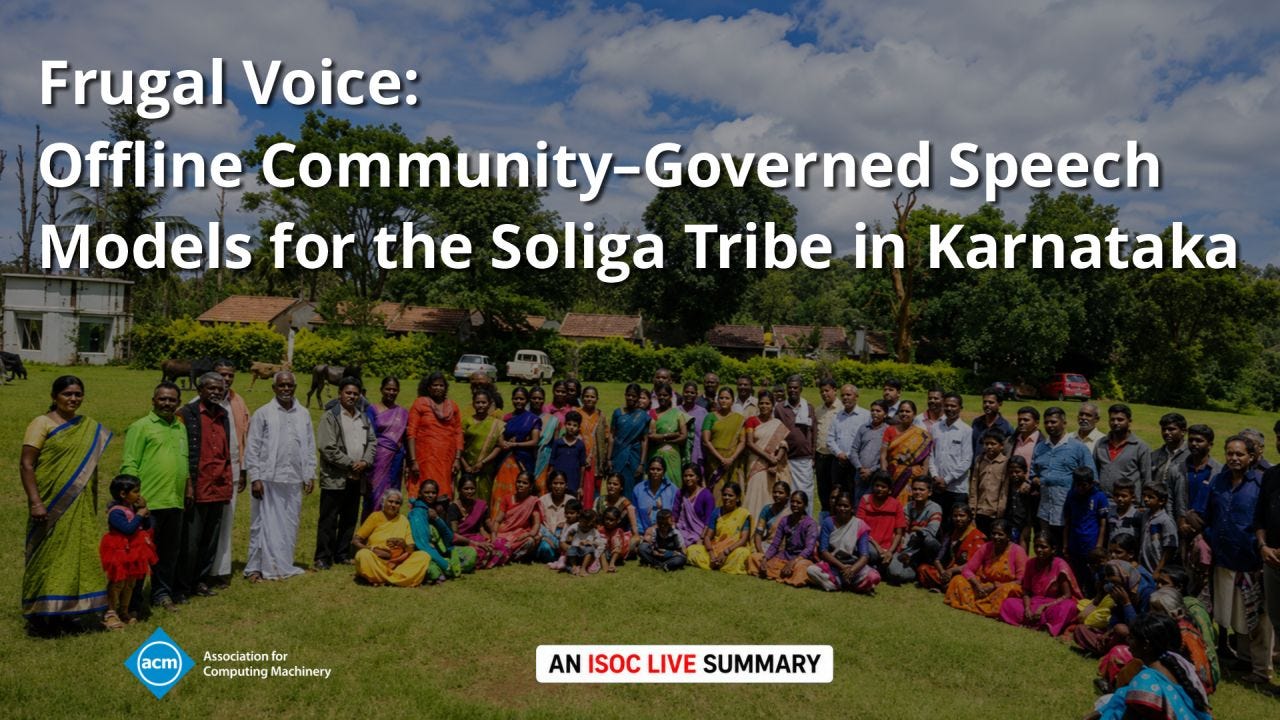
Paper: Frugal Voice: Offline Community–Governed Speech Models for the Soliga Tribe in Karnataka
Authors: Sarbani Banerjee Belur — IIIT Dharwad; Nandha Sathiaseelan — Hills Road Sixth Form College; Prashant Bannulmath — IIIT Dharwad; Sunil Saumya — IIIT Dharwad; Shruti Maralappanavar — IIIT Dharwad; Deepak K T — IIIT Dharwad; S R Mahadeva Prasanna — IIIT Dharwad; Arjuna Sathiaseelan — Cambridge Judge Business School
Published in: ACM SIGCAS/SIGCHI Conference on Computing and Sustainable Societies (COMPASS ‘26), 27–31 July 2026, Virtual Event, USA, pp. 447–456
DOI: 10.1145/3811242.3819092 · Licensed CC BY 4.0
The problem
The paper addresses the digital exclusion of India’s tribal and low-resource languages, taking Soliga as its case. Soliga is a morphologically rich Dravidian language spoken in the Biligiri Rangaswamy Hills of Karnataka; it is exclusively oral, with no widely adopted standardised script. The authors argue that contemporary speech technology — centralised, cloud-hosted, dependent on large labelled corpora, stable connectivity, and GPU compute — is structurally misaligned with the infrastructural and socio-economic realities of tribal communities in India. Their answer is a socio-technical framework and prototype combining frugal AI, offline edge-based federated learning, and community governance.
The framing question is deliberately narrow: can a community-governed federated architecture approach a centralised ASR baseline while running entirely on low-cost, intermittently connected devices — and how do Soliga speakers themselves judge such a system?
Why Soliga, and why governance first
The Soliga are an Adivasi forest-dwelling community living in and around the Biligiri Rangaswamy Temple (BRT) Tiger Reserve in Chamarajanagar district. Their settlements, known as podus, are dispersed within or along the fringes of the forest canopy, often lacking paved road access and situated far from markets, schools, and health facilities. Electricity is intermittent; cellular coverage is weak, fragmented, or absent. The community numbers several tens of thousands.
Governance is not incidental to the design. Following the Forest Rights Act of 2006, the Soliga became the first tribal community in India to secure formal community forest rights within the core area of a tiger reserve — a legal and cultural precedent the paper reads directly into contemporary demands for data sovereignty. The authors note that the community views extraction of linguistic and cultural data by external researchers with well-founded scepticism.
Development therefore begins with a co-design process involving community leaders, local NGOs, and linguists to define acceptable use cases, agree data governance rules, and identify trusted local institutions to host aggregation nodes. Consent protocols are developed in the Soliga language, and participants opt into or out of specific uses — research only, or research plus downstream applications. Data ownership is assigned to the community through a local cooperative structure that formally controls any sharing of model artefacts beyond the community.
Participation is tiered:
Tier 1 — volunteer speakers contributing recordings on community-owned devices
Tier 2 — local facilitators who manage devices, explain consent, and monitor training cycles
Tier 3 — a community data council that oversees when and how global models are updated, deployed, or shared externally, reviews new deployment proposals including external research collaborations, and holds veto power
Data collection
Speech is recorded on low-cost Android smartphones and Raspberry Pi-class edge boxes with USB microphones. The prompt set is balanced across everyday phrases relating to health, education, and public services; short narratives and folk stories recorded with elder speakers; and phonetically rich sentences adapted from existing Soliga linguistic documentation and from Kannada corpora mapped to Soliga phonology.
Two datasets result: an ASR corpus of 10,000 utterances (5 hours) of read and semi-spontaneous speech, and a TTS corpus of 4,200 utterances (4 hours) recorded under more controlled conditions for future synthesis work. Recordings are stored locally in compressed 16 kHz mono form (Opus/FLAC), tagged with minimal metadata — age bracket, gender, consent tier — and no personally identifying information. On-device quality checks using signal-to-noise thresholds and duration limits filter unusable samples before training.
The 5-hour ceiling is a deliberate constraint. It reflects realistic documentation budgets for non-orthographic tribal languages and lets the authors test whether a frugal federated architecture remains viable under extreme data scarcity.
Model tasks
Rather than a general-purpose conversational system, the work targets two tightly scoped tasks:
Keyword spotting (KWS) over roughly 30 health- and service-related phrases — Soliga equivalents of doctor, hospital, medicine. The model is a compact convolutional network operating on log-Mel spectrogram patches with depthwise-separable convolutions to cut parameter count and computation.
Automatic speech recognition (ASR) mapping Soliga speech to Kannada-script transliteration, following the strategy used in earlier Soliga documentation and Indic ASR work. The architecture is a small encoder-decoder: 3–4 layers of bidirectional GRUs or a compact Conformer-style stack, with a character- or subword-level attention decoder predicting Kannada script tokens.
Keyword labels derive from prompt templates; ASR transcripts are produced by bilingual annotators from the community using Kannada script. To reduce annotation burden, unlabelled segments receive pseudo-labels from the current global model, which annotators then verify or correct.
Both models are compressed via post-training 8-bit quantization, with optional pruning of low-magnitude weights after initial training, and are initialised through knowledge distillation from a larger teacher model trained in a controlled environment where a small amount of de-identified surrogate data can be shared under community-approved conditions.
Federated training and offline synchronisation
The technical core is a cross-device federated protocol built for intermittent connectivity. The community edge server — a mini-server at a local NGO or school — holds the current global model, compressed and versioned. When devices come into local Wi-Fi range, for example at weekly community meetings, they receive the latest snapshot by local file transfer. Each device extracts features on-device, applies augmentation, trains on locally stored audio for a fixed number of steps under energy and time constraints, computes model deltas, and compresses them through quantization and sparsification. Only those updates are uploaded, at the next connectivity window. No raw audio leaves the device.
The server performs a weighted FedAvg update over participating devices, with simple norm- and loss-based checks to catch malformed or outlier contributions. Local batch sizes and epoch counts are capped to keep training feasible on low-power hardware.
Devices are assumed to run disconnected for weeks. Each maintains a queue of unsent updates tagged with the global model version they were trained against; on reconnection, the aggregator applies pending updates in order or discards obsolete deltas when version skew grows too large, and can group updates by originating version.
The overall architecture has three layers: a device layer of phones and edge boxes for collection, local training, and inference; a community edge layer hosting the always-on aggregation server and a governance dashboard for the data council; and an optional external support layer of university or NGO servers that may receive anonymised model snapshots — not raw updates — and only with explicit community approval.
Privacy safeguards include on-device encryption of stored audio with device-level PINs managed by local facilitators, opt-out mechanisms that trigger local deletion of recordings and exclusion from future training rounds, and model-card documentation co-written with the community specifying intended use, limitations, and prohibited uses such as surveillance or profiling.
Results
The evaluation is a simulation rather than a field deployment: ten simulated edge clients on a single server, each holding a per-speaker slice of the corpus, with a random subset participating in each round to approximate sporadic connectivity.
Three conditions are compared — a centralised Wav2Vec 2.0 baseline trained on all 5 hours, a local-only baseline with no aggregation between clients, and the federated frugal model. The federated model is initialised from a small Wav2Vec 2.0-distilled seed trained centrally on the same corpus plus limited community-approved surrogate data.
Centralised (Wav2Vec 2.0): 37.95% WER · 11.11% CER · 0.91 keyword-spotting F1
Local-only, no federation: 68.50% WER · 29.40% CER · 0.62 F1
Federated frugal (theirs): 44.20% WER · 15.80% CER · 0.84 F1 · 12 minutes per training round · 340 KB per update
Federation costs roughly 6.3 WER points against the centralised baseline while recovering 24.3 points against purely local training — the paper’s central result. The training time is measured on Raspberry Pi 4-class hardware and is compatible with overnight or background operation; the update size sits comfortably inside what an occasional local Wi-Fi window can carry.
On where this sits against the state of the art, the authors are direct. Whisper Large-V2 fine-tuned on Soliga reports 22.09% WER, the lowest published figure for the language, and both models here perform substantially worse. The frugal architecture deliberately accepts a 16–22 WER-point gap in exchange for sub-$50 hardware that runs entirely offline under community control. The paper also positions its results against other low-resource Indic systems for Lambani, Kannada, and Garhwali — where the federated Soliga model compares favourably — while cautioning that corpus sizes and evaluation protocols differ across languages.
What the community said
Interviews and focus groups covered 24 Soliga participants across three villages: eight elder speakers, ten younger bilingual adults, and six community leaders and NGO staff. Sessions ran in Soliga with translation support from Tier 2 facilitators. Three themes emerged.
Data sovereignty and trust. Participants consistently valued that recordings did not leave community-controlled devices and that the data council held veto power over external sharing. Several elders contrasted the project with earlier extractive recording campaigns in which, as they put it, stories and songs were taken away without community benefit.
Instrumental value. Younger bilingual speakers saw the KWS model as a practical tool for dealing with government health services, NGOs, and educational resources — navigating automated health information lines, conveying medication names to Kannada-speaking clinicians. An F1 of 0.84 was judged sufficient for these constrained interactions, particularly where a bilingual facilitator can intervene on a recognition error.
Cultural preservation. Elders prioritised folk stories, medicinal knowledge, and ritual songs over transactional phrases, and saw Kannada-script transliteration as a possible bridge for intergenerational transmission. They also raised concerns that Kannada script may misrepresent Soliga phonology, and argued for community-controlled annotation and validation workflows.
Limitations the authors name
The ASR dataset is 5 hours from a modest number of speakers — typical for first-round documentation of a non-orthographic language, but tiny by conventional standards, limiting both model capacity and the statistical robustness of the evaluation. The federated results come from simulation rather than devices in the field, and future deployments will need to validate the protocol under realistic power cycles and participation patterns. The qualitative component is exploratory rather than representative, omitting sub-groups such as migrant workers and younger urbanised speakers. Energy figures rest on coarse battery-level statistics rather than direct power metering, which the authors acknowledge weakens the frugal AI claims.
The sharpest gap is a governance one. Individual participants can withdraw, triggering local deletion and exclusion from future rounds, but the system supports no community-level rollback of specific model versions. Mechanisms for community-initiated model retirement or “un-training” remain an open problem, technical and governance alike.
Where it goes next
Three technical directions: extending the framework to tribal languages with contrasting phonological and governance contexts, such as Lambani and Gondi, to test how the methodology transfers and how community councils negotiate inter-community model sharing; building simple on-device interfaces that let speakers flag mis-recognised tokens or culturally inappropriate outputs back into training; and hybrid regimes in which a small anonymised, community-approved subset trains larger teacher models in a controlled environment while students stay small and edge-deployable — potentially narrowing the gap to Whisper-scale performance without conceding data sovereignty.
Beyond the technical, the authors call for sustained engagement with policymakers and standards bodies to formalise community rights over voice data and models, drawing on indigenous data governance frameworks such as OCAP® and current debates on AI and Indigenous data sovereignty. Their closing position: federated and frugal architectures can be made to work for tribal speech in India, but the next step is embedding them in durable institutional arrangements that protect community interests over the long term.
Conclusions
The paper concludes that community-governed federated speech models offer a viable middle ground between a fully centralised ideal and isolated local training — allowing Soliga speakers to build and control ASR and keyword-spotting models on low-cost hardware without relinquishing their voice data. Recognition accuracy stays well short of large cloud models, and the approach still depends on a centrally trained seed; what it changes is where the audio lives and who decides what happens to it. The authors’ central claim is that governance structure matters as much as learning algorithm in building speech technology a community will trust.
Glossary
The community and the language
Adivasi — collective term for India’s Indigenous peoples; the Soliga are one such community.
Dravidian — the language family of southern India, including Kannada, Tamil, and Soliga.
Podu — a small, dispersed Soliga hamlet inside or on the fringe of the forest.
Transliteration — writing the sounds of one language in another language’s script; here, Soliga speech written in Kannada characters because Soliga has no script of its own.
Speech technology
ASR (automatic speech recognition) — software that turns spoken audio into text.
KWS (keyword spotting) — a much smaller task than full recognition: detecting whether one of a fixed set of words was spoken, rather than transcribing everything.
TTS (text-to-speech) — the reverse of ASR: generating spoken audio from written text.
WER / CER (word / character error rate) — the share of words or characters a system gets wrong; lower is better.
F1 — a single accuracy score between 0 and 1 balancing missed detections against false alarms; higher is better.
Wav2Vec 2.0 — a widely used open speech model from Meta, here fine-tuned on Soliga as the centralised comparison point.
Whisper — OpenAI’s large multilingual speech recognition model; the “Large-V2” version holds the best published Soliga result.
Log-Mel spectrogram — a visual representation of audio frequencies over time, the standard input format for speech models.
Encoder–decoder — a two-part model design: one part compresses the audio into an internal representation, the other turns that into text.
Training and compression
Edge device — hardware that runs computation locally rather than sending it to the cloud; here, cheap Android phones and Raspberry Pi boards.
Federated learning — a training method in which each device learns from its own data and shares only the resulting model adjustments, never the underlying data.
FedAvg — the standard federated algorithm for combining those adjustments into one shared model, weighted by how much data each device contributed.
Model deltas — the changes a device makes to a model during local training, as distinct from the model itself.
Quantization / sparsification / pruning — three ways of shrinking a model or its updates: storing numbers less precisely, sending only the values that changed most, and deleting connections that contribute little.
Knowledge distillation — training a small “student” model to imitate a larger “teacher” model, so the student inherits some of its capability at a fraction of the size.
Pseudo-labels — machine-generated draft transcripts that human annotators then check and correct, reducing manual transcription work.
Governance
Data sovereignty — the principle that a community retains authority over data generated by and about it, including how it is stored, used, and shared.
OCAP® — Ownership, Control, Access and Possession, a First Nations framework for Indigenous data governance, cited here as a precedent.
Model card — a short public document stating what a model is for, where it fails, and what uses are prohibited.
RESOURCES
Frugal Voice: Offline Community–Governed Speech Models for the Soliga Tribe in Karnataka — the paper itself, open access under CC BY 4.0
ACM COMPASS 2026 — the SIGCAS/SIGCHI conference on computing and sustainable societies, held virtually 27–31 July 2026
The Saving Voices Project — the volunteer initiative behind the Soliga study, co-founded by four of the paper’s authors
Accelerating a Frugal AI Ecosystem — the Frugal AI Hub white paper the authors situate their design within
IIIT Dharwad — home institution of six of the eight authors, including the speech processing work behind the models
Evaluating the Efficacy of Large Acoustic Models for Documenting Non-Orthographic Tribal Languages in India — source of the 22.09% Whisper Large-V2 result for Soliga that the paper measures itself against
Federated Learning for Keyword Spotting — Leroy et al., the communication-budget benchmark for the 340 KB update figure
Communication-Efficient Learning of Deep Networks from Decentralized Data — McMahan et al., the paper that introduced the FedAvg algorithm used here
wav2vec 2.0: A Framework for Self-Supervised Learning of Speech Representations — the model used both as centralised baseline and as the distilled seed
The First Nations Principles of OCAP® — the Indigenous data governance framework the authors cite as precedent