

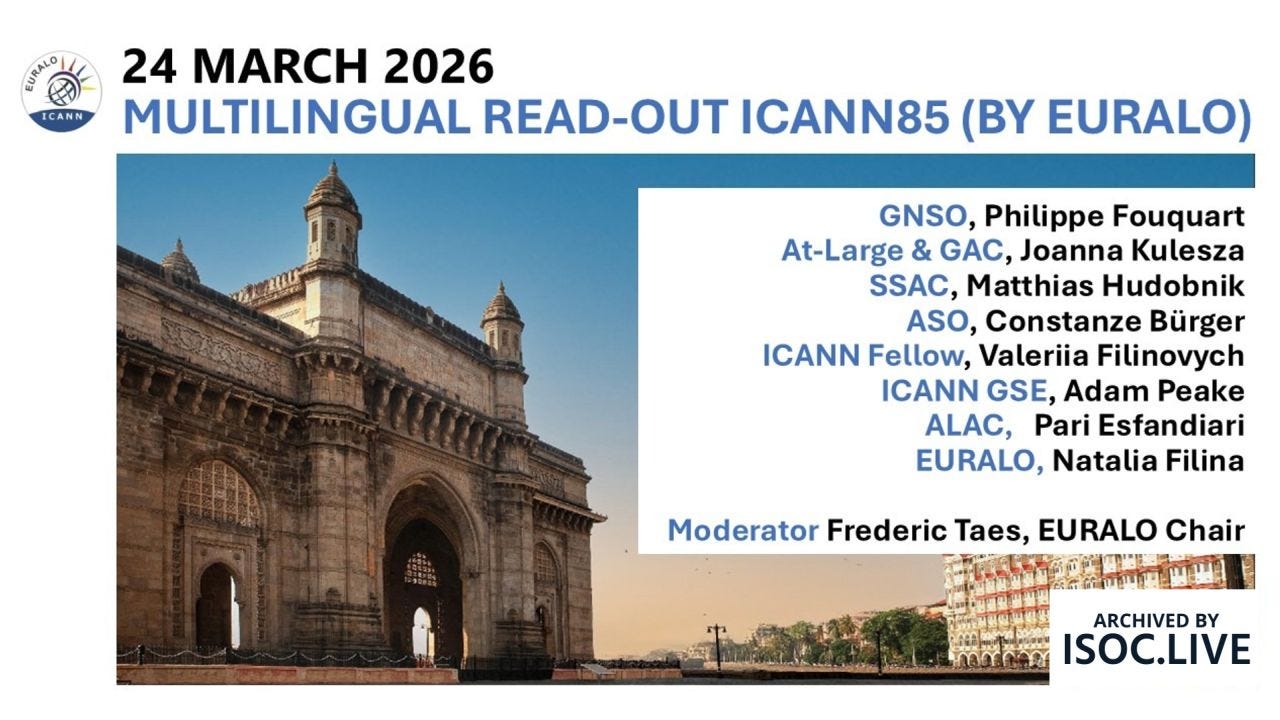
EURALO Multilingual Read-Out ICANN85
March 24, 2026
VIDEO | AUDIO | RECAP EN / ES / FR | ARCHIVE | PERMALINK
Speakers: Philippe Fouquart (GNSO/ISPCP); Joanna Kulesza (At-Large & GAC); Matthias Hudobnik (SSAC); Constanze Bürger (ASO); Valeriia Filinovych (ICANN Fellow); Adam Peake (ICANN GSE); Pari Esfandiari (ALAC);
Moderators: Frédéric Taes (EURALO Chair); Natalia Filina (EURALO Secretary)
Facilitator: Michelle DeSmyter (ICANN Policy Support)
This EURALO roundtable provided a comprehensive, multistakeholder read-out of ICANN85 in Mumbai, structured around two guiding questions: key takeaways from the meeting and priorities heading toward ICANN86 in Seville. The discussion highlighted strong convergence across constituencies on DNS abuse, the upcoming new gTLD round, institutional reform, and the growing impact of AI and geopolitics on Internet governance.
GNSO Perspective – Philippe Fouquart
Fouquart emphasized DNS abuse as the dominant policy priority, with the newly launched PDP seen as both long-awaited and existential given increasingly sophisticated, AI-driven abuse patterns. He also highlighted:
· Imminent launch of the next round of gTLDs (late April)
· “Review of Reviews” as a response to community overload
· ISP engagement on AI and Universal Acceptance
· ICP-2 policy reform for RIR governance
Top priorities: DNS abuse PDP and ICP-2 completion.
At-Large & GAC – Joanna Kulesza
Kulesza reinforced alignment between At-Large and GAC, particularly on DNS abuse and domain registration data accuracy. Key themes:
· AI-enabled abuse (e.g., domain generation algorithms)
· Need for stronger registrant verification and earlier checks
· Privacy/proxy service challenges (PPSAI)
· Strong focus on applicant support quality in the new gTLD round
· WSIS+20 as a strategic context reinforcing multistakeholder governance
She stressed balancing security, privacy, and enforcement in an AI-driven environment.
SSAC – Matthias Hudobnik
Hudobnik framed ICANN85 around a shift from “stability” to “survivability” of the DNS. Highlights included:
· DNSSEC evolution, automation, and post-quantum planning
· Research on resolver behavior and error resilience
· AI-driven cyber threats
· Technical work on new DNS record types and security
Priority: expand end-user awareness (CyberSafe campaign) and deepen engagement on open-source and security resilience.
ASO – Constanze Bürger
Bürger focused on ICP-2 reform and RIR governance:
· Updating a 25-year-old framework to reflect today’s Internet
· Addressing gaps in RIR accountability, transparency, and recognition
· Broad community consultation underway
Timeline: final document expected by end of 2026.
Fellowship Perspective – Valeriia Filinovych
Filinovych highlighted accessibility challenges within ICANN:
· High complexity and barriers for newcomers and academics
· Limited visibility of ICANN in research communities
· Strong need for structured academic engagement
She emphasized integrating Internet governance into university curricula and research.
ICANN GSE – Adam Peake
Peake provided participation metrics and strategic context:
· 1,400+ participants, 112 countries
· Continued hybrid participation model
· Strong focus on Universal Acceptance and inclusion
Key priorities:
· Successful launch of the new gTLD round
· Strengthening outreach with measurable outcomes
· Expanding academic and regional engagement
· Preparing for ICANN86 in Seville
He underscored UA as foundational for digital inclusion globally.
ALAC Perspective – Pari Esfandiari
Esfandiari offered a broader, critical reflection:
· Gap between ICANN discussions and real-world Internet disruptions
· Increasing entanglement of ICANN with global governance and geopolitics
· Need to align institutional reforms with external change
She raised questions on ICANN’s legitimacy, relevance, and responsiveness, particularly in the context of Internet shutdowns and digital sovereignty.
Community Input & Discussion
Audience feedback highlighted:
· Urgency and concerns around the new gTLD round timeline
· DNS abuse progress as a positive development
· Importance of remote participation (with time zone challenges)
· Need for stronger outreach, youth inclusion, and applicant support
Geopolitical concerns (e.g., travel barriers, meeting locations) and institutional accountability were also raised.
RESOURCES
DNS Abuse Mitigation PDP 1 (Associated Domain Checks) — the GNSO policy development process launched December 2025, discussed at length by Philippe Fouquart and Joanna Kulesza
New gTLD Program: 2026 Round — application window opens 30 April 2026; the upcoming round referenced throughout the session
ICP-2 Review — ASO Address Council — the RIR governance document update process presented by Constanze Bürger
UN General Assembly Adopts WSIS+20 — the December 2025 outcome reaffirming the multistakeholder model, referenced by Joanna Kulesza and Adam Peake
ICANN Security and Stability Advisory Committee (SSAC) — the advisory body whose full ICANN 85 week was summarised by Matthias Hudobnik
NIXI — National Internet Exchange of India — the Mumbai meeting host organisation praised by multiple speakers
Universal Acceptance Day (UA Day) — events running 25 March – 30 May 2026, highlighted by Adam Peake alongside the new gTLD round’s IDN implications
ICANN At-Large Community — the end-user community hub central to EURALO’s work and Pari Esfandiari’s presentation on ICANN’s legitimacy
ICANN DNS Abuse Mitigation Program — including the INFERMAL project and Domain Metrica tool, providing the research base for DNS abuse policy discussions
EURALO — European Regional At-Large Organization — the host organisation; next event: gTLD round table 31 March 2026, then ICANN 86 in Seville, June 2026