

Blue Origin FCC Application – Project Sunrise Orbital Data Center System (Summary)
March 19, 2026
Overview
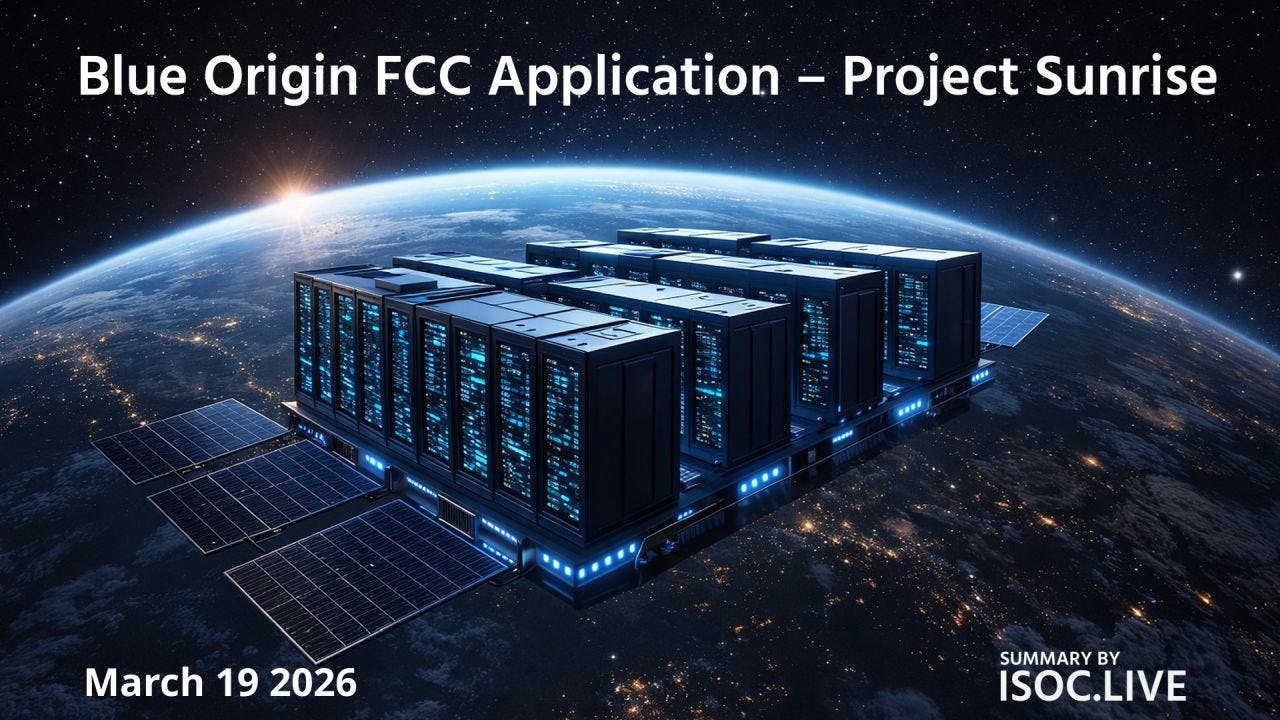
Blue Origin has filed an application with the Federal Communications Commission seeking authorization to deploy and operate Project Sunrise, a massive non-geostationary satellite constellation designed to host data centers in space.
The proposal envisions:
Up to 51,600 satellites
Sun-synchronous orbits at 500–1,800 km altitude
Primary reliance on optical inter-satellite links
Limited use of radio spectrum (Ka-band) for control and reliability functions
Project Concept: Space-Based Data Centers
Project Sunrise introduces a new model of computing infrastructure:
Orbital data centers performing AI and cloud workloads in space
Powered by near-continuous solar energy
Independent of terrestrial constraints such as:
Land availability
Electrical grid capacity
Water usage
The system is positioned as a complement—not replacement—to Earth-based data centers, adding a new “compute tier” beyond terrestrial infrastructure.
Rationale and Public Interest Case
Addressing Infrastructure Constraints
Blue Origin argues that:
Demand for AI and cloud computing is outpacing terrestrial capacity
Data centers face growing constraints in:
Power supply
Cooling (water use)
Physical space
Space-based infrastructure could:
Expand total compute capacity
Reduce pressure on Earth’s resources
Provide low-carbon compute powered by solar energy
Expanding AI Accessibility
The application emphasizes broader societal benefits:
Lower-cost compute could enable:
Healthcare improvements (diagnostics, early detection)
Precision agriculture
Personalized education
Climate modeling
By reducing infrastructure bottlenecks, Project Sunrise aims to:
Democratize access to AI compute
Support U.S. technological competitiveness
Technical Architecture
Constellation Design
Satellites distributed across multiple orbital planes
Each plane: ~300–1,000 satellites
Variants of spacecraft optimized for coverage needs
Communications
Primary: Optical inter-satellite links (laser-based)
Secondary (TT&C):
Ka-band frequencies:
18.8–19.3 GHz (downlink)
28.6–29.1 GHz (uplink)
Used for telemetry, tracking, and command
Operates on a non-interference, non-protected basis
This design minimizes spectrum use and reduces interference risk.
Spectrum and Regulatory Position
Blue Origin stresses that:
The system will not rely on RF spectrum for core data transmission
RF use is limited to:
Early mission phases
Backup and safety operations
Key claims:
No harmful interference with existing operators
Compatibility with current and future NGSO systems
Efficient use of allocated Ka-band spectrum
Waiver Requests
Blue Origin requests multiple regulatory waivers to accelerate deployment:
1. Processing Round Waiver
Avoid standard FCC spectrum-sharing application rounds
Justification:
No spectrum exclusivity requested
No interference risk
Optical-first architecture reduces conflicts
2. Milestone & Surety Bond Waiver
Relief from:
Deployment deadlines (50% in 6 years, full in 9 years)
Financial bond requirements
Argument:
No risk of “spectrum warehousing” due to non-exclusive use
3. Technical Filing Flexibility
Waivers for:
Incomplete design details (system still evolving)
Simplified orbital data submission
Strategic Context
Project Sunrise builds on Blue Origin’s broader ecosystem:
Launch systems:
New Shepard (reusable suborbital)
New Glenn (heavy-lift orbital)
Supporting infrastructure:
TeraWave communications network
Blue Ring orbital mobility platform
The application positions the company as moving beyond launch services into space-based infrastructure and computing markets.
Key Implications
For Space Industry
Signals a shift toward space as a computing platform
Introduces competition in orbital data infrastructure
For AI Ecosystem
Potential to:
Increase compute supply
Reduce costs
Enable new applications
For Regulation
Challenges existing frameworks:
Spectrum allocation
Satellite licensing
Orbital congestion management
Conclusion
Blue Origin’s Project Sunrise represents an ambitious attempt to extend cloud and AI infrastructure into orbit at unprecedented scale. By combining optical networking, solar-powered satellites, and massive constellation deployment, the proposal aims to redefine how and where computing capacity is built.
The FCC’s decision will likely have broader implications for:
Space commercialization
AI infrastructure development
The future balance between terrestrial and orbital systems
RESOURCES
Blue Origin Project Sunrise – FCC Application — the original FCC filing (SAT-LOA-20260310-00118)
Blue Origin — Jeff Bezos’ space venture and applicant behind Project Sunrise
TeraWave — Blue Origin’s planned 5,408-satellite broadband constellation, announced January 2026
New Glenn — Blue Origin’s heavy-lift orbital launch vehicle
FCC Space Bureau — the FCC division handling satellite licensing and orbital data center applications
SpaceX Orbital Data Center Application — SpaceX’s competing filing for up to one million orbital data center satellites
Starcloud — startup that filed its own FCC application for 88,000 orbital data center satellites
The Rapid Rise of Space-Based Internet: Broadband from Above — related ISOC LIVE coverage, Congressional Internet Caucus Academy panel, March 11, 2026
International Astronomical Union – Satellite Constellation Concerns — IAU position on growing mega-constellations and astronomical interference