

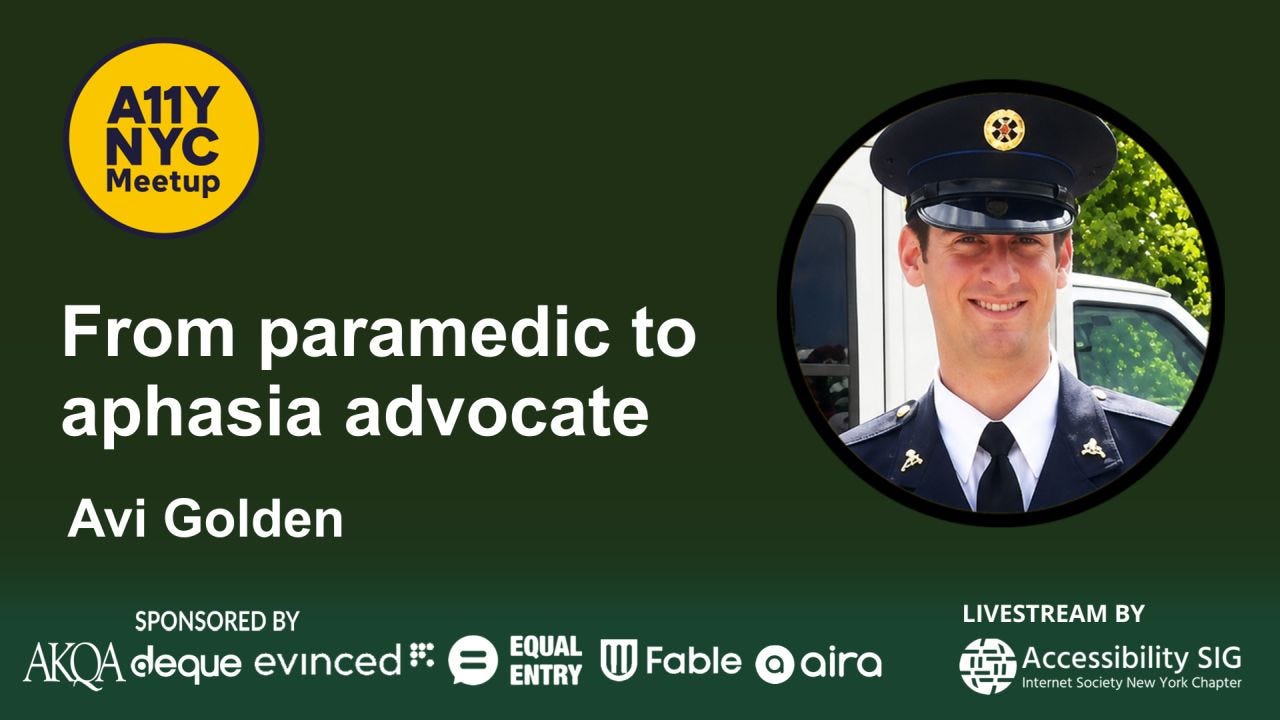
From paramedic to aphasia advocate – Avi Golden
Accessibility NYC Meetup - August 4, 2026
VIDEO | AUDIO | RECAP EN / ES / FR | ARCHIVE | PERMALINK
Speaker: Avi Golden – aphasia advocate and former critical-care and flight paramedic
Moderators: Ben Ogilvie – A11Y NYC; Irina Morozova – A11Y NYC
Life Before and After the Stroke
Avi Golden described his life before the stroke that caused his aphasia approximately 19 years ago. He worked as a critical-care and flight paramedic, had experience in Israel, and was preparing to attend medical school. He spoke both English and Hebrew.
Golden suffered the stroke as a complication of surgery. He spent several months in the hospital receiving occupational, physical, and speech therapy. Although he can still understand Hebrew, he can no longer speak, read, or write it.
He was diagnosed with Broca’s aphasia. He generally understands what other people say but has difficulty producing language, particularly names, numbers, letters, and short words. Immediately after the stroke, the only word he could say was “Michael,” although he remains unsure why that particular name emerged.
Golden continues to work with a speech-language pathologist every day. His language has improved steadily, but he emphasized that recovery is extremely slow and that every person with aphasia has a different experience.
Communication Tools and Strategies
Golden said phonetic prompts, semantic cues, and patient conversational partners help him retrieve words. Writing remains especially frustrating, including seemingly simple words that other people may take for granted.
Voice-recognition technology has therefore become essential. He uses Nuance Dragon to convert his speech into text for email, messaging, and other written communication. Although imperfect, it enables him to communicate in situations where writing independently would be difficult.
Later, Golden explained that many mainstream dictation systems still struggle with atypical speech. A system may transcribe the wrong word without making the error apparent to him, leaving him unable to judge whether the resulting text is correct.
He nevertheless described AI as potentially “amazing” for people with aphasia. AI tools can often infer the intended meaning of his imperfectly composed texts and WhatsApp messages, making them more understandable to recipients. He cautioned that aphasia varies considerably, however, so a tool that helps one person may not work for another.
Discovering Aphasia as a Patient
Golden knew the clinical meaning of aphasia while working as a paramedic but did not understand its lived reality. After his stroke, he encountered a definition describing it simply as difficulty naming objects correctly. That brief description did not convey the condition’s complexity, frustration, or effect on a person’s life.
His experience also transformed his understanding of speech-language pathology. As a paramedic, he was familiar with doctors, nurses, physician assistants, occupational therapists, and physical therapists, but had barely been aware of the speech-language pathologists working in hospitals.
Doctors can diagnose aphasia and identify its neurological cause, he explained, but speech-language pathologists conduct more detailed assessments and work directly with patients over time. Their frequent contact enables them to understand the particular characteristics and severity of each person’s communication difficulties.
Aphasia Education and Advocacy
Golden began contacting emergency medical services, police departments, fire departments, hospitals, and professional organizations to offer aphasia-awareness training. These presentations generally combine clinical information from a speech-language pathologist with testimony from one or more people living with aphasia.
He has spoken with emergency personnel, medical residents, doctors, nurses, physician assistants, rehabilitation professionals, and speech-language pathology students. His presentations have taken him to locations in New York, New Jersey, Colorado, Los Angeles, and Israel, as well as online events.
Golden has also participated in programs associated with the National Aphasia Association, universities, professional conferences, and the American Speech-Language-Hearing Association. He wants clinicians and first responders to move beyond knowing the definition of aphasia and develop a practical understanding of how to recognize and communicate with someone who has it.
He also visits hospital patients who have recently experienced strokes. By sharing his own story, he hopes to show them that aphasia does not necessarily end an active or socially engaged life.
Visibility and Isolation
Golden expressed concern that many people leave the hospital after developing aphasia, return home, and withdraw from society. Some stop participating in activities or pursuing therapy because communication has become so difficult.
He contrasted this isolation with the possibilities created by continuing speech therapy, meeting other people, and participating in community activities. Recovery differs greatly between individuals, but he believes that continued engagement can improve communication, confidence, and quality of life.
Golden also discussed aphasia as a non-apparent disability. A person may not display any obvious physical impairment, causing others to misunderstand speech difficulties or assume reduced intelligence. Greater public awareness can help people respond with patience rather than judgment.
“Aphasia: The Movie”
Golden highlighted “Aphasia: The Movie,” a short film based on the experience of actor Carl McIntyre, who developed aphasia after a stroke. The film depicts the communication barriers and emotional consequences of the condition.
He presented storytelling by people with aphasia as an important form of education. Personal accounts give clinicians, emergency workers, students, and members of the public a more realistic understanding than a medical definition alone can provide.
An Adventurous Life
Golden was already drawn to adventurous activities before his stroke, including skydiving, scuba diving, and hiking. Afterward, he began searching online for accessible recreation and discovered a much larger adaptive-sports community than he had known existed.
He presented an extensive range of activities available to people with disabilities, including:
Horseback riding, gliding, sailing, handcycling, rowing, tennis, golf, boxing, archery, rock climbing, surfing, skiing, snowboarding, and swimming
Indoor and outdoor skydiving, scuba diving, zip-lining, paintball, off-road driving, water skiing, ski biking, hot-air ballooning, and snowmobiling
Falconry, dog sledding, yoga, dancing, rugby, adaptive boating, and encounters with dolphins, sea lions, manta rays, and other animals
Many programs provide equipment, guides, or physical assistance tailored to individual needs. Golden encouraged people to contact organizers directly and ask whether an activity could accommodate their disability.
He emphasized that many of these opportunities are free or substantially less expensive than conventional adventure programs. He maintains information about accessible activities in and around New York City, elsewhere in the United States, and internationally, and offered to share relevant resources with attendees.
Adaptive-Sports Organizations
Golden cited numerous organizations and facilities offering adaptive recreation, including Helen Hayes Hospital, Burke Rehabilitation Hospital, Freedom’s Wings International, Life Rolls On, Row New York, Nyack Boat Club, Northeast Off-Road Adventures, Leaps of Faith Adaptive Skiers, the Impossible Dream accessible catamaran, and the Abilities Expo.
He described Freedom’s Wings as an accessible gliding program in New Jersey whose pilots include wheelchair users. The Impossible Dream catamaran travels along the East Coast and enables people with disabilities to participate in sailing. Helen Hayes and Burke offer numerous adaptive-sports programs through their rehabilitation networks.
The Abilities Expo brings together adaptive equipment, services, sports demonstrations, and disability organizations at several locations. Golden recommended it as an effective starting point for discovering activities and meeting program providers.
No Barriers Summit
Golden was particularly enthusiastic about the No Barriers Summit, a multi-day gathering combining adaptive outdoor activities with talks by people with disabilities, wounded veterans, young people, and athletes.
Participants can try activities such as skiing, snowboarding, and hiking during the day and hear personal accounts in the evening. Golden cited blind mountaineer Erik Weihenmayer and adaptive athlete Kyle Maynard as examples of people who challenge conventional assumptions about disability.
For Golden, these events are powerful not merely because they provide recreation, but because they create community, visibility, and opportunities for people with disabilities to learn from one another.
Service-Dog Assistance
Asked how his service dog, Dodge, assists with aphasia, Golden explained that the dog’s role is not language interpretation. Dodge helps with practical tasks that can become difficult because of Golden’s other post-stroke limitations, such as retrieving socks from a drawer.
Golden praised Canine Companions for providing highly trained assistance dogs without charging recipients. Dodge also accompanies him to presentations, conferences, and recreational activities.
Human Connection and Technology
One participant observed that digital and AI-based solutions cannot replace face-to-face interaction with therapists and other people. Drawing on 13 years of personal speech-therapy experience, the participant emphasized the importance of sustained human relationships in rehabilitation.
Golden agreed about the importance of human support but did not see technology and personal interaction as mutually exclusive. Speech-language pathologists provide individualized clinical knowledge and encouragement, while dictation and AI tools help him manage written communication and participate more independently in everyday life.
Continuing Goals
Golden’s goals encompass both personal recovery and public education. He continues daily speech therapy and is committed to improving his communication, even when progress is slow. At the same time, he wants emergency personnel and healthcare professionals to understand aphasia from the patient’s perspective.
He has also resumed involvement with emergency medical services as a volunteer. This return to EMS reconnects him with his professional identity while allowing him to use his experience as both a former paramedic and a person with aphasia.
Golden concluded that disability need not eliminate adventure, community participation, professional contribution, or enjoyment. His advocacy seeks to help people with aphasia leave isolation, locate supportive communities, and discover activities they may have assumed were no longer possible.
RESOURCES
National Aphasia Association — runs the Aphasia Awareness Training for Emergency Responders project Avi contributes to
Adler Aphasia Center — Maywood NJ center whose annual play Avi was performing in the day after the talk
Aphasia: The Movie — Carl McIntyre’s 40-minute film about his own stroke and aphasia
Canine Companions — provider of Avi’s service dog Dodge, free to recipients
Tikkun Olam Makers — three-day makeathons building open-source assistive technology
Freedom’s Wings International — free adaptive glider flying in New Jersey, run by pilots with disabilities
Life Rolls On — adaptive surfing through its “They Will Surf Again” summer events
No Barriers — summit pairing daytime adaptive sport with evening storytelling
Abilities Expo — free disability expo with six or seven US locations
Northeast Off-Road Adventures — SOAR adaptive off-road program in Ellenville NY, 90 minutes from the city