

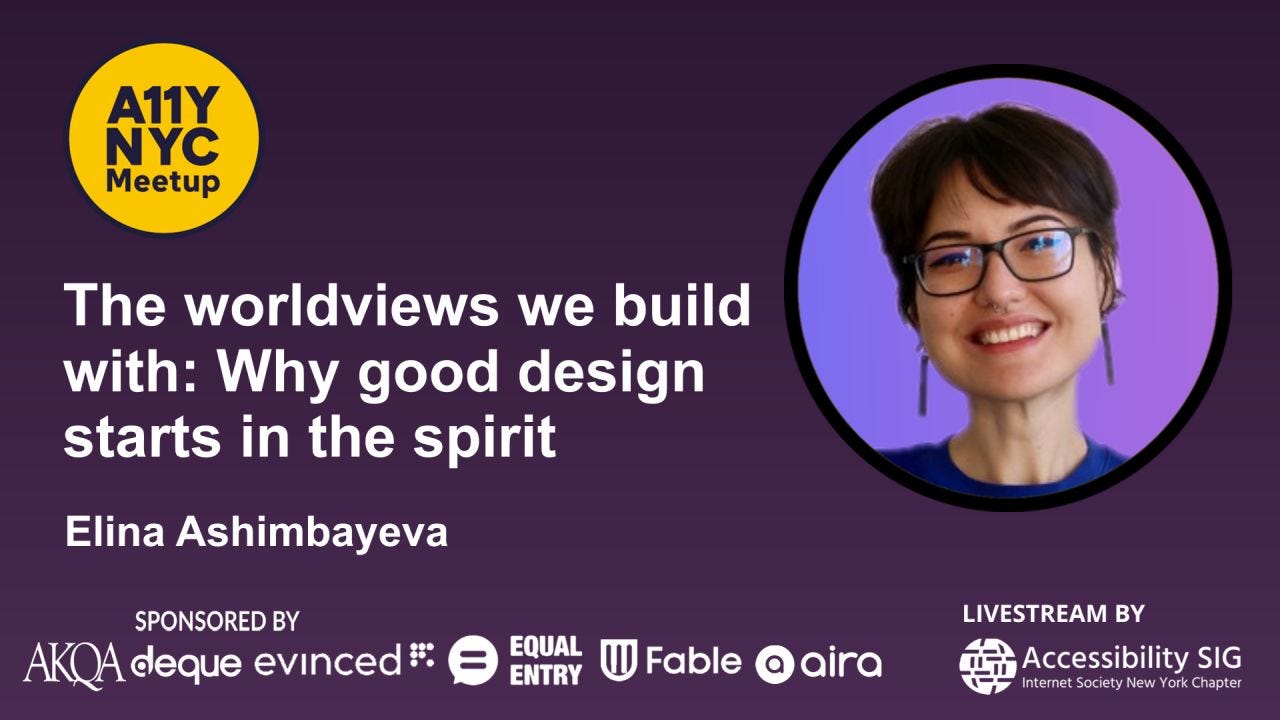
The worldviews we build with: Why good design starts in the spirit
Accessibility NYC Meetup - July 7, 2026
VIDEO | AUDIO | RECAP EN / ES / FR | ARCHIVE | PERMALINK
Speaker: Elina Ashimbayeva – Storyo / Making Good Money
Moderator: Ben Ogilvie – ArcTouch / A11yNYC
Opening: Designing from the inside out
Elina Ashimbayeva opened by framing the session as an exploration of the values and worldviews that shape design long before products, interfaces, or technologies are created. Rather than focusing on accessibility techniques or product checklists, she argued that inclusive design begins with the beliefs, assumptions, and relationships of the people creating systems.
Using artwork inspired by evolutionary biologist Lynn Margulis, she introduced the idea of co-evolution: organisms that might otherwise compete instead develop through cooperation. She suggested this provides a useful metaphor for collaborative creation, emphasizing coexistence over competition.
She invited attendees to begin with a traditional Māori karakia from New Zealand, explaining that it serves not as a religious prayer but as a practice of arriving together, centering attention, and acknowledging shared purpose before beginning collective work.
Personal journey
Ashimbayeva introduced herself through photographs illustrating different parts of her life:
growing up between Kazakhstan and New Zealand;
interviewing Thomas, one of the meetup organizers, for her podcast Making Good Money;
her background studying biomedical science, including cancer research using zebrafish models;
her recent focus on poetry and creative work.
Professionally, she described three major strands of experience:
service design and innovation at Health New Zealand (Te Whatu Ora), where she worked on healthcare services, hospital design, digital products, and clinical communications;
founding a storytelling platform that interviewed hundreds of people on subjects including migration, domestic violence, refugee experiences, and sexual health;
developing practical methods for helping product teams build more equitable and inclusive technologies through research practices, accessibility tools, and design frameworks.
Across all these experiences, she found herself repeatedly asking what qualities individuals and teams must cultivate if they genuinely want to build ethical, diverse, and inclusive technologies.
Starting with ourselves
Ashimbayeva contrasted conventional product thinking with a different progression:
ourselves
our teams
our products
She argued that organizations often assume the primary work lies in improving products, while Indigenous approaches she encountered in New Zealand instead emphasize beginning with the people creating those products.
She also introduced the idea of “microcultures.” Rather than waiting for executives or organizations to change, individuals can transform the culture immediately around them. Small teams can establish new norms that eventually influence broader organizational behavior.
She challenged attendees who consider themselves progressive to recognize that everyone absorbs assumptions from the wider culture, making continual self-examination necessary rather than assuming one’s values are already settled.
Looking beneath the iceberg
A central framework in the presentation was the “iceberg” model of systems change.
Visible outcomes occupy only the top of the iceberg:
observable problems
symptoms
measurable results
Below the surface lie deeper layers:
organizational structures
underlying paradigms
trauma
life force or foundational values
Drawing on work from the Emerge Institute and Indigenous perspectives from New Zealand, Ashimbayeva argued that lasting change requires engaging these deeper levels rather than repeatedly treating visible symptoms.
She suggested many humanitarian, policy, and accessibility efforts fail because they modify systems without examining the assumptions producing those systems in the first place.
Using artificial intelligence as an example, she proposed that if efficiency is society’s dominant value, then AI is not an unexpected disruption but a predictable consequence. Likewise, inaccessible products emerge naturally when growth and efficiency consistently outweigh inclusion.
Accessibility as a systems problem
Ashimbayeva illustrated the iceberg model through accessibility.
A visible problem might be:
a screen reader user cannot use a website.
Looking deeper reveals additional layers:
product teams may include no people with disabilities;
accessibility testing may never occur;
offices may themselves be inaccessible;
organizational priorities may consistently favor rapid growth over inclusion.
The inaccessible website therefore represents the visible consequence of decisions made much earlier and much deeper within the organization.
Positive examples of inclusive design
Rather than focusing on failures, Ashimbayeva deliberately chose examples of successful inclusion.
She highlighted Air New Zealand’s booking system, which offers detailed options for passengers with different accessibility needs, including multiple mobility, vision, hearing, and assistance categories.
She cited Spotify’s shuffle button redesign, where a small dot supplements the color change, enabling users with color blindness to distinguish active and inactive states.
She described tactile reproductions used by the Louvre to allow blind and low-vision visitors to experience artwork through touch.
She also discussed accessibility initiatives implemented by Woolworths supermarkets in Australia and New Zealand, including:
visual emergency alarms;
improved contrast;
wider aisles;
mobility scooter parking;
staff accessibility training;
quiet shopping hours with reduced lighting and sound for customers sensitive to overstimulation.
These examples illustrated that accessibility extends well beyond compliance and can influence every aspect of the user experience.
Reducing hidden bias
Ashimbayeva recounted the well-known example of blind auditions in orchestras.
Separating judges from performers with a screen significantly increased the selection of women. Additional changes, including having performers wear soft shoes to eliminate the sound of high heels, further reduced unconscious bias.
She used this example to demonstrate that many forms of discrimination arise unintentionally through system design rather than explicit prejudice.
Inclusive research practices
Drawing from healthcare projects, Ashimbayeva described comprehensive frameworks her teams used when conducting user research.
Rather than merely recruiting participants, researchers examined questions such as:
whether meeting times excluded working people;
whether venues felt welcoming to marginalized communities;
whether digital participation assumed reliable Internet access;
whether religious locations discouraged some groups from attending;
whether moderators and communication styles built sufficient trust.
She also described Hello Access, a platform she helped develop that hires people with disabilities to conduct real usability testing. Users record their experiences navigating websites, while AI summarizes the findings into prioritized accessibility backlogs and roadmaps. Companies can watch real interactions rather than relying solely on automated accessibility reports.
Mental models
Ashimbayeva then shifted from systems toward the beliefs that create those systems.
She argued that organizations ultimately express the qualities of the people within them:
integrity or lack of integrity;
cooperation or domination;
relationships with truth;
attitudes toward power.
Without transformation at this level, organizational reform simply reproduces existing patterns.
Interactive reflection
Ashimbayeva invited attendees to raise their hands if various assumptions had influenced their work or organizations.
Examples included beliefs such as:
money reflects human worth;
privacy is an acceptable trade for convenience;
user attention drives growth;
time is always scarce;
every transaction produces winners and losers;
relationships naturally weaken as organizations scale;
ethical compromises are acceptable if wealth later supports philanthropy;
hard work now allows eventual escape from work;
success depends upon scale;
metrics determine value.
The exercise emphasized that these assumptions often operate unconsciously even among people committed to equity and accessibility.
Alternative values
Ashimbayeva contrasted those assumptions with alternative principles she hopes to cultivate:
challenges deepen personal capacity;
money reflects how it is earned;
communities depend upon mutual obligation;
scale should serve purpose rather than personal escape;
endings and constraints are healthy parts of life;
not everything should scale;
human flourishing is interconnected;
excellence matters more than expansion;
meaningful change often extends beyond one’s own lifetime.
She emphasized that these are not abstract philosophical ideals but practical commitments shaping every decision designers make.
Concluding reflections
Ashimbayeva concluded that meaningful systems change rarely begins with dramatic reforms. Instead, it begins with quiet, continual reflection:
noticing internal assumptions;
questioning inherited values;
examining definitions of productivity, success, and worth;
intentionally choosing different ways of working.
She argued that these apparently intangible practices are actually the deepest and most consequential work designers can undertake. If teams collectively value community, excellence, and mutual responsibility over efficiency alone, the products they create will inevitably reflect those values.
Questions and discussion
During the discussion, participants explored how behavioral science can support accessibility work. Ashimbayeva responded that individuals often underestimate their ability to influence their immediate environments. Rather than waiting for organizational permission, she encouraged people to improve their own teams and workflows, arguing that cultural change spreads outward through local examples.
Asked how to define inclusivity, she rejected the idea of a fixed destination. Instead, she described inclusion as an ongoing process of identifying barriers, listening to affected users, and addressing one problem at a time. She illustrated this with an example from a music education application, where feedback from a one-armed drummer led the team to redesign drum lessons to accommodate different physical abilities.
A discussion about capitalism and community examined whether competitive economic systems inevitably conflict with collective wellbeing. Ashimbayeva pointed to growing experiments with cooperatives and community-centered models while stressing that meaningful change begins with personal initiative rather than waiting for institutions to act. Another participant suggested replacing financial measures of success with wellbeing and health as the primary goals of organizational systems, a perspective Ashimbayeva welcomed.
She also described Indigenous decision-making practices in New Zealand, where consensus is reached by continuing discussion until everyone can support a decision rather than relying on majority voting. Although slower, she suggested this process better reflects relationships and shared responsibility.
Responding to a question about intentionally choosing not to care about certain metrics, Ashimbayeva reflected on her own struggle with podcast statistics and social media numbers. She said she regularly reminds herself to prioritize meaningful human responses over audience size, describing this as an ongoing practice rather than a problem permanently solved.
Asked about the impact of service design within New Zealand’s healthcare system, she explained that although many innovation teams had since been dismantled under a new government, their relational, human-centered approach had significantly improved collaboration with clinicians and policymakers while those teams were active.
In the final exchange, a participant asked how to sustain personal commitment to these values when organizational culture appears resistant. Ashimbayeva emphasized the importance of mentors, teachers, and reflective communities that continually redirect attention from changing the entire world toward the everyday work of examining one’s own judgments, relationships, and actions.
RESOURCES
The worldviews we build with: Why good design starts in the spirit — the A11yNYC event page for this talk
Elina Ashimbayeva — presenter; product manager, facilitator, and experience designer
A11yNYC Meetup — monthly accessibility and inclusive design events in New York City
Storyo — Elina’s storytelling platform, 200+ interviews with women and gender-diverse people in Aotearoa
A Model for Healing and Restoration — the Emerge Institute iceberg model of paradigms, trauma, and life force behind the talk
Creating a New World — Dr Kat Eghdamian’s Substack on justice, spirituality, and purpose
Lily Zheng — DEI strategist whose work on microcultures Elina cited
The Visitors by Jane Harrison — the play about the First Fleet’s arrival, referenced in the Q&A
Lynn Margulis — evolutionary biologist behind the co-evolution theory in the opening slide
ArcTouch — where host Ben Ogilvie leads accessibility