

Scaling Accessibility with Design Systems
Accessibility NYC Meetup - June 2, 2026
VIDEO | AUDIO | RECAP EN / ES / FR | ARCHIVE | PERMALINK
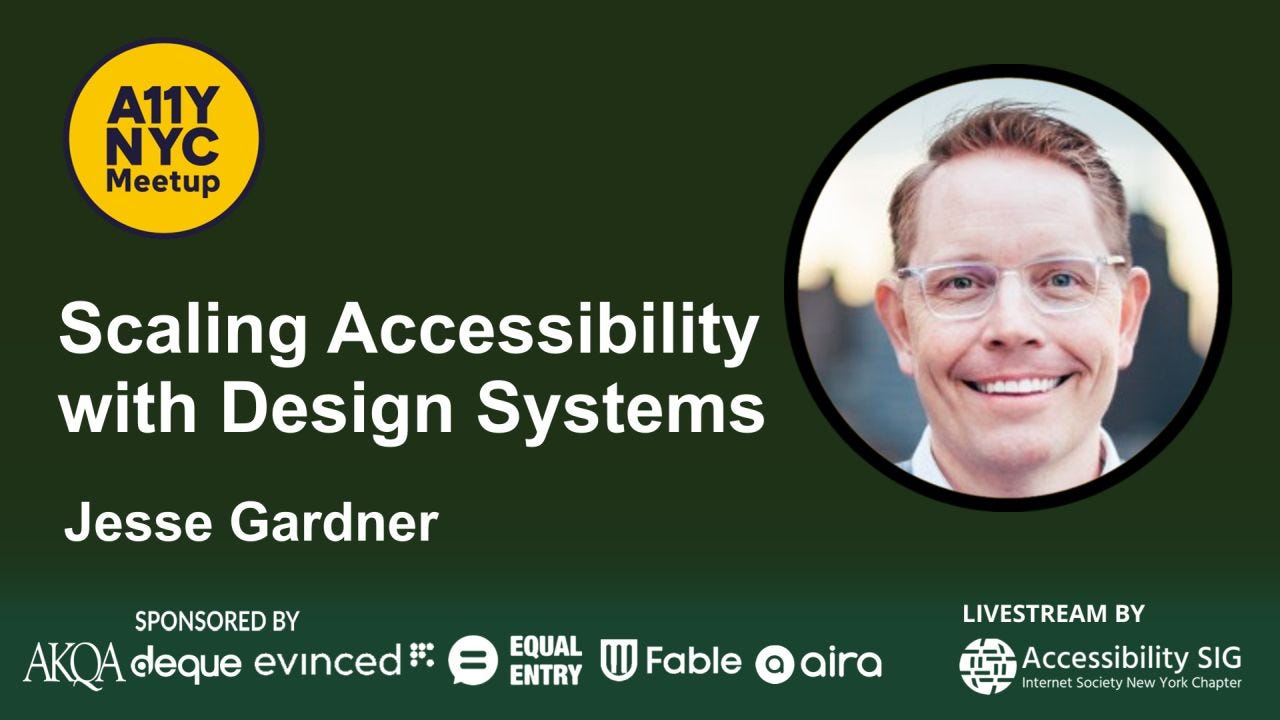
Speakers: Jesse Gardner - NYS Office of Information Technology Services
Moderator: Irina Morozova - A11yNYC
Jesse Gardner outlined how New York State is attempting to scale digital accessibility across hundreds of government websites and services through a centralized design system initiative. Drawing on his background in both design and engineering, Gardner described the longstanding friction between design intent and implementation, particularly in large organizations where teams work independently, technologies vary widely, and accessibility expertise is unevenly distributed.
Gardner framed accessibility as fundamentally tied to usability and customer experience. He described the fragmented experience many New Yorkers encounter when interacting with state services online: users move between different websites, authentication systems, and application platforms without realizing they are crossing organizational boundaries. While agencies may operate distinct systems internally, residents simply want to accomplish tasks such as paying taxes or renewing licenses, and inconsistent interfaces create cognitive burden and erode trust in government services.
To illustrate the scale of inconsistency, Gardner showed dozens of different button styles collected from New York State websites. Each variation represented duplicated effort in design, engineering, and testing. Beyond visual inconsistency, he emphasized that accessibility failures are often hidden beneath the interface layer. Keyboard navigation, screen reader labeling, focus management, and semantic structure frequently break in ways invisible to sighted users but highly disruptive for blind or low vision users.
Gardner stressed that most accessibility failures are not intentional. Rather, developers are often asked to manage too many responsibilities without sufficient accessibility training. New York State therefore established a centralized accessibility and design systems effort within its human-centered design team to provide practical guidance and scalable solutions. He highlighted collaboration with existing agency accessibility efforts, particularly the DMV team, which had informally become a resource for other agencies before the centralized initiative launched.
He introduced members of the state accessibility team and explained that their work spans user research, accessibility testing, design systems, training, and standards development. The team focuses heavily on understanding user needs across disability categories and translating accessibility requirements into practical workflows engineers can understand and implement.
A major driver for the work has been regulatory pressure. Gardner referenced upcoming compliance requirements tied to DOJ accessibility rules and New York State technology law deadlines. He noted that WCAG 2.2 AA can feel overwhelming for teams unfamiliar with accessibility, so the group’s role is often to interpret the standards in plain language and turn them into actionable engineering guidance.
The accessibility team began by conducting manual accessibility testing on high-priority public workflows across agencies. Gardner explained that the purpose was not only to identify issues but also to build relationships with engineering teams and understand the realities they face. Because the state employs thousands of engineers while the accessibility team numbers only seven people, their long-term strategy focuses on raising organizational maturity rather than serving as a permanent centralized audit group.
Gardner described the team’s testing process as both technical and educational. Agencies receive detailed reports listing issues and WCAG violations, but the team also conducts engineering-focused review sessions that explain accessibility problems in terms of user impact. Instead of merely telling teams what to fix, they explain why a problem matters for users and how to implement solutions. He characterized these sessions as safe spaces for engineers to ask questions and build understanding rather than compliance exercises.
The presentation emphasized the importance of shifting accessibility earlier into the design and development process. Gardner referenced the well-known principle that testing becomes more expensive the later issues are discovered, and argued that scalable accessibility depends on embedding accessible patterns directly into the systems teams use every day.
He also highlighted broader cultural initiatives including biweekly accessibility office hours, internal knowledge bases, Teams channels for accessibility support, and role-specific guidance documentation. These efforts are intended to normalize accessibility conversations across agencies and create a collaborative culture rather than a compliance-only mindset.
Gardner then turned to the New York State Design System itself, defining it as a collection of components, design tokens, accessibility standards, and usage guidance intended to help teams rapidly build usable and accessible digital services. He described three core pillars:
A code component library
A design prototyping library
A design system reference site
The system is intended to align with existing New York State brand standards while standardizing interaction patterns and accessibility behaviors across services.
The code component library forms the technical core of the initiative. Gardner compared it conceptually to Google Material Design: a centralized set of tested interface components such as buttons, accordions, toggles, and inputs. These components have built-in accessibility support including keyboard navigation, focus handling, and screen reader compatibility. Engineers can copy example code directly into projects, accelerating implementation while ensuring accessibility and brand consistency.
Gardner explained that the system uses web components, allowing accessibility logic and behavior to be encapsulated within reusable custom HTML elements. He cited disconnected form labels as one of the most common accessibility failures discovered during testing. By baking label associations directly into reusable components, agencies no longer need to implement those accessibility relationships manually. He also noted that the components can be adapted for multiple frameworks and platforms including React, Angular, and Drupal.
The design prototyping library was presented as equally important because it reduces friction between designers and developers. Using shared “Lego blocks” in both design and engineering workflows helps preserve design intent during handoff and creates a common language between disciplines. Gardner also discussed the use of design tokens, such as predefined accessible color palettes and semantic color definitions, which allow agencies to inherit accessibility-tested visual patterns even when they are not using full components.
The reference website serves as the public-facing documentation hub for the design system. Gardner emphasized that engineers do not visit the site because they are interested in accessibility itself; they come because they need practical tools to build applications. By making accessible components easy to adopt, the team effectively creates opportunities to teach accessibility principles within the engineering workflow. Component pages therefore combine implementation guidance with accessibility education and checklists.
Gardner described additional “build accessible” guidance for agencies unable to adopt the design system directly because of funding constraints or legacy systems. These resources explain how to implement accessible patterns using native HTML and CSS even when teams cannot migrate to the centralized component library.
Returning to the broader mission, Gardner reiterated that the goal is not to make every state website visually identical, but to create consistency in interaction patterns and accessibility behaviors so residents can navigate services more reliably.
He concluded the formal presentation by describing the team’s Global Accessibility Awareness Day activities. The group created interactive demonstrations where participants navigated intentionally inaccessible interfaces using only keyboards or screen readers. Gardner said these exercises often create breakthrough moments for engineers, helping them understand why semantic structure, landmarks, and focus order matter in practice.
During the Q&A session, participants asked about incremental adoption, versioning, Open Source licensing, accessibility in educational platforms such as BrightSpace, organizational resistance to change, and measuring adoption and user outcomes.
Gardner explained that the design system is Open Source and designed for extensibility. Agencies can override styles using CSS variables while still benefiting from accessible defaults. He noted that adoption has necessarily been incremental: the design system launched with roughly 15 components and has since expanded to around 30. The team focuses on pragmatic gains, encouraging agencies to adopt whatever portions can immediately reduce accessibility burden.
Responding to a question about higher education accessibility practices, Gardner stressed the importance of manual testing alongside automated scanners. He gave an example from the design system site itself where repetitive screen reader announcements passed automated scans but created a poor user experience in practice. He also encouraged mandatory accessibility training wherever possible, even if lightweight, to raise baseline awareness among content creators and instructors.
On organizational resistance, Gardner said compliance deadlines have been an important motivator, but emphasized that the team tries to lead with user needs rather than fear. He described the realities of government funding cycles, where many systems move into maintenance mode without resources for large-scale redesigns. As a result, the accessibility team often prioritizes practical improvements that allow users to complete workflows, even if the experience remains imperfect.
In response to questions about metrics and user outcomes, Gardner explained that the broader human-centered design organization places strong emphasis on user research and testing. The design system team tracks adoption across design and engineering workflows while also treating the system itself as a repository of proven patterns that can scale usability improvements to projects lacking dedicated research resources.
RESOURCES
New York State Design System — the reference site, component library, and design tokens Jesse Gardner’s team built
NYS Design System on GitHub — the open-source, Lit-based web component library
NYS Design System Figma Community File — the community design library with all components and custom theming
Plasticmind (Jesse Gardner) — the speaker’s site, writing on bridging design and engineering
DOJ ADA Title II Web Rule — the 2024 final rule on state and local government web accessibility
DOJ Compliance-Date Extension (IFR) — the rule extending deadlines a year, referenced in the talk
WCAG 2.2 — the W3C accessibility standard (Level AA) the team targets
U.S. Web Design System — the federal design system Jesse cited as having a similar accessibility checklist
Lit — the web components framework underlying the NYS Design System
A11yNYC — Scaling Accessibility with Design Systems — the meetup event page for this talk