

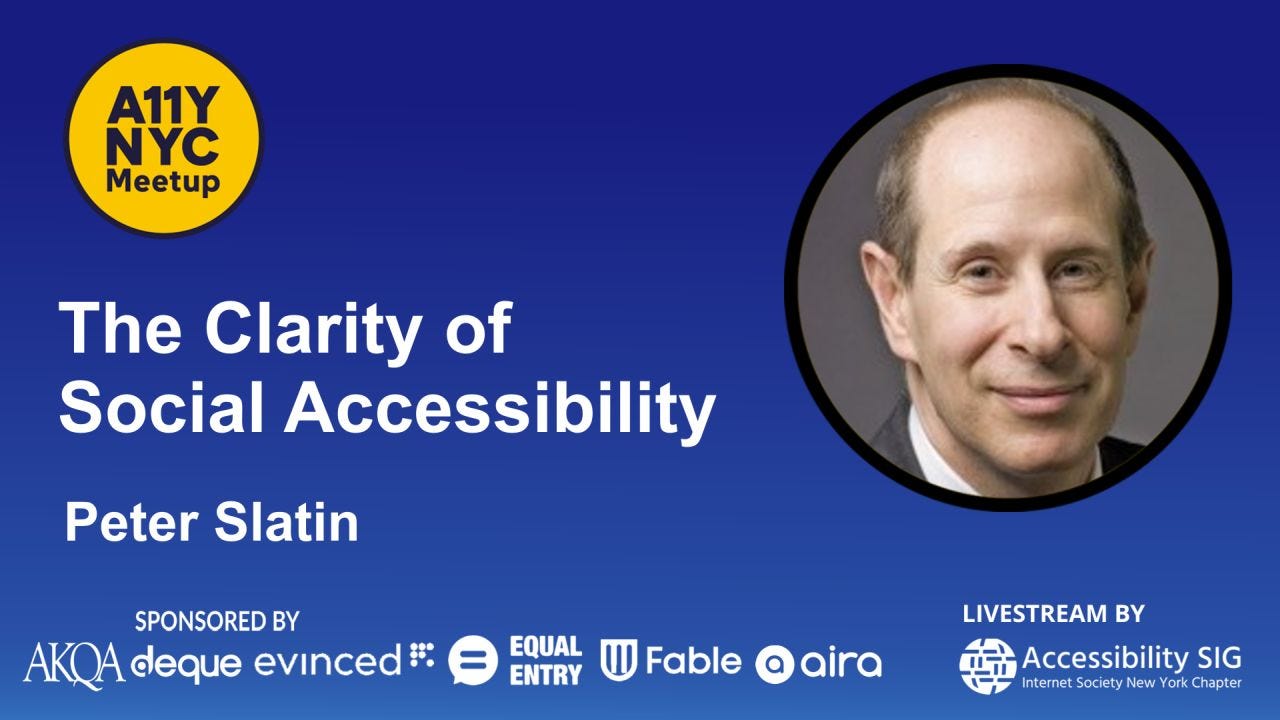
The Clarity of Social Accessibility - Peter Slatin
Accessibility NYC Meetup - May 5 2026
VIDEO | AUDIO | RECAP EN / ES / FR | ARCHIVE | PERMALINK
Speaker: Peter Slatin - Slatin Group
Host / Moderator: Ben Ogilvie - A11yNYC
Peter Slatin opened by thanking Thomas Logan, Ben Ogilvie, Meryl Evans, the Accessibility NYC team, and both in-person and online attendees. He introduced himself humorously and personally, describing himself as a 71-year-old blind white man accompanied by his yellow lab guide dog, Inga. He acknowledged that the audience may have expected a talk centered on digital accessibility, but clarified that his focus would instead be “social accessibility” — the human recognition and understanding that underpin both physical and digital accessibility.
Slatin described social accessibility as fundamentally connected to recognition. In his view, inaccessible systems persist because people with disabilities are not fully recognized as participants in society. He argued that obvious accessibility barriers often remain unresolved because decision-makers do not truly perceive disabled people or their lived realities.
He shared his own history with retinitis pigmentosa and macular degeneration. Although born legally blind, he became functionally blind later in life. Initially trained as a painter after studying at Hunter College, he discovered in college that his visual field was only ten degrees rather than the typical 180 degrees, and that his vision would continue to deteriorate. He continued painting for roughly fifteen years as his sight gradually declined.
Eventually, Slatin transitioned into journalism, specializing in architecture, design, commercial real estate, and development reporting. He recalled receiving a hostile handwritten response from Donald Trump after publishing a critical article in the early 2000s, joking that he still keeps the note in a “very cheap plastic frame.”
He also described his evolving mobility journey: beginning white cane use in his early thirties, later adopting guide dogs after being struck by a yellow cab in Midtown Manhattan. Inga, he explained, is his fourth guide dog.
Encounters with Exclusion and the Emergence of Social Accessibility
Slatin explained that while reporting on architecture and real estate, he generally avoided becoming “a professional blind person,” preferring to work within mainstream journalism rather than disability-focused advocacy. However, over time, repeated experiences of exclusion and ignorance pushed him toward activism.
He recounted writing about the Cooper Hewitt Museum renovation, which added an accessible ramp so then-director Dianne Pilgrim, a wheelchair user, could independently enter the building. He saw this as an example of accessibility becoming necessary only after institutions recognized the lived needs of disabled people.
More formative were several deeply personal incidents involving discrimination and misunderstanding. One occurred at the former Tishman Building at 666 Fifth Avenue, where a security guard physically trapped him and his guide dog inside a revolving door after shouting that dogs were not allowed inside. Another occurred at Eataly around 2012, where staff informed him their lawyers considered him and his guide dog a liability and barred him from entering the store.
Slatin described the Eataly incident as the moment he decided to dedicate himself professionally to advancing social accessibility. The problem, he argued, was not merely inaccessible infrastructure but the ignorance and fear embedded in customer service, security, hospitality, and workplace interactions.
He emphasized that regulations like the Americans with Disabilities Act and WCAG can only go so far. Standards and guidelines cannot by themselves bridge the gap created by social misunderstanding. Human awareness and recognition are needed to “fill in” the spaces between technical compliance and real inclusion.
Historical Exclusion and Disability Identity
Using slides from the Museum of Disability History, Slatin explored historical examples of exclusion. One image showed cognitive puzzles administered to immigrants at Ellis Island to determine whether they were fit to become U.S. citizens. He connected these practices to broader historical patterns of defining disabled people as socially or economically burdensome.
He argued that disability has historically been framed through two extremes: either the “superhuman” disabled person who overcomes extraordinary odds, or the “miserable creature” viewed as a burden on family and society. Both narratives, he said, fail to recognize disabled people as ordinary human beings with equal dignity and value.
Slatin stressed that despite major advances — including increased education, employment, wealth, and political visibility within disability communities — society still struggles to recognize disabled people fully. He linked this persistent disconnect to deeply rooted historical beliefs about productivity, usefulness, and social worth.
Critique of Inclusion and Empathy
One of the central philosophical themes of the talk was Slatin’s critique of the concepts of “inclusion” and “empathy.”
He argued that inclusion often implies an existing group generously inviting outsiders into a space they already control. Disabled people, however, are already part of society and should not require permission to belong. For this reason, he preferred frameworks grounded in recognition and equity.
Similarly, he expressed skepticism toward empathy as commonly practiced in design and accessibility education. He criticized simulation exercises involving blindfolds, earplugs, or wheelchairs as forms of “disability tourism” that create false understanding rather than genuine insight. According to Slatin, such exercises often reduce disability to fear and limitation rather than lived experience.
Drawing on research by Cynthia Bennett and Daniela Rosner, he discussed how designers frequently consult disabled people temporarily, then return to designing from nondisabled assumptions. This dynamic results in products that fail to incorporate disabled perspectives meaningfully, even after accessibility testing.
He argued that empathy can become a shortcut that substitutes superficial emotional reaction for sustained engagement and structural understanding. Instead, he urged designers and organizations to hire disabled people directly and integrate disability perspectives into the design process from the beginning.
Disability History, Activism, and Collective Action
Throughout the presentation, Slatin repeatedly emphasized the importance of disabled people creating their own solutions and communities rather than waiting for institutions to act.
He discussed examples from disability arts and activism, including collaborative organizing during the COVID-19 pandemic among disabled, queer, and marginalized communities who used online spaces not only for support but for creating culture and solidarity.
Additional slides explored disability history themes including HIV/AIDS activism, eugenics, and assistive technologies. Slatin noted that disabled people were among the first victims murdered under Nazi eugenics programs and described how American and German eugenics movements shared ideological roots during the early twentieth century.
He also discussed the “Mouthstick,” a simple assistive tool enabling quadriplegic users to type and communicate, presenting it as an example of disabled communities inventing practical solutions for themselves.
Another example was the “Blue Bench” artwork by Finnegan Shannon, which encouraged visitors to sit and rest as resistance to societal pressure toward constant productivity and conformity.
The InvaCar and the Limits of Well-Meaning Design
Slatin devoted considerable attention to the British “InvaCar,” a small vehicle designed for disabled veterans after World War II. While acknowledging its innovative intentions and aesthetic qualities, he used it as an example of accessibility designed without sufficient disabled input.
The vehicles had dangerous stability problems, limited storage, no room for passengers, and remained government-owned rather than personally owned by users. As wheelchair technology improved and disabled communities sought greater social connection, the InvaCar became increasingly inadequate.
For Slatin, the InvaCar illustrated how accessibility efforts can fail when disabled people are not meaningfully involved in the design process.
Museum of Disability History and Accessibility as a Design Foundation
Slatin concluded the formal presentation by discussing the newly reopened Museum of Disability History at the Viscardi Center on Long Island. He described the museum’s thematic structure, its collection of roughly 8,000 objects, and its use of digital tools like Bloomberg Connects to broaden access.
He emphasized that accessibility must function as a foundational design principle rather than a retroactive compliance exercise. In architecture and design education, he argued, accessibility is still too often treated as an afterthought instead of an organizing framework equivalent to light, form, usability, or legibility.
He connected disability history and accessibility history as parallel struggles against exclusion and misunderstanding, both requiring sustained collective action and recognition.
His final reflection referenced Tricia Hersey’s “Nap Ministry,” which frames rest itself as resistance against exploitative social systems. Slatin connected this philosophy to broader disability justice ideas about rejecting constant productivity demands and valuing human dignity over performance.
Q&A Session
During the discussion session, José Garcia asked whether Slatin regretted not engaging in disability advocacy earlier in life.
Slatin responded that he both did and did not regret it. While proud of his earlier artistic and journalistic career, he wished he had pursued art more explicitly as a disabled artist. He reflected on learning later in life that his pediatric ophthalmologist had diagnosed his condition when he was six years old but never informed his family, leaving him without important knowledge or support during formative years.
Asked online about non-apparent disabilities, Slatin said he preferred the phrase “non-apparent” over “hidden” or “invisible,” which he felt implied shame. He acknowledged that disability communities and institutions alike still struggle to address these experiences fully and stressed the importance of listening directly to people living with such disabilities.
He also shared a metaphor from actor Imani Russell, who described autism not as a spectrum with highs and lows but as a pie in which all slices are equal.
Sam Berman asked about the term “belonging” as an alternative to “inclusion.” Slatin said he preferred it somewhat but felt terms like diversity, inclusion, belonging, and equity often become interchangeable corporate language detached from deeper structural questions. He emphasized that equity and recognition remained most important to him.
Xian Horn introduced the phrase “deep integration” to describe genuinely weaving disabled people into organizations and communities rather than simply inviting them into existing structures. Slatin responded positively, appreciating the idea of integration as the opposite of social fragmentation.
Horn also expressed shock that the Eataly incident occurred as recently as 2012 rather than before the ADA. Slatin noted that although the incident angered him deeply, it also revealed how poorly frontline workers are often trained and how accessibility efforts require support from both leadership and operational staff.
Another online question asked how designers could move beyond empathy as the dominant framework. Slatin reiterated that empathy alone is insufficient and argued that organizations need disabled employees and sustained internal engagement rather than simulations or surface-level exercises.
The final question addressed why many nondisabled people avoid interacting with disabled people due to uncertainty or fear. Slatin described what he called the “contagion response,” an instinctive fear of disability rooted partly in historical associations with disease and vulnerability. He argued that the best way to overcome this fear is through ordinary interaction and recognition that disabled lives contain the same mixture of joy, struggle, routine, and aspiration as anyone else’s.
He concluded by emphasizing that disability is not horror or tragedy but simply another form of living, and that social accessibility begins when society recognizes this shared humanity.
RESOURCES
A11yNYC — Accessibility NYC Meetup, host of this event
Slatin Group — Peter Slatin’s accessibility-training consultancy
Museum of Disability History — reopened February 2026 at The Viscardi Center on Long Island
John Slatin AccessU 2026 — Knowbility’s annual conference, named for Peter’s late brother
The Promise of Empathy — Cynthia Bennett & Daniela Rosner’s CHI 2019 paper on empathy in disability design
The Nap Ministry — Tricia Hersey’s rest-as-resistance project
Rest Is Resistance — Tricia Hersey’s 2022 manifesto, the basis for the framework Peter closed with
Do you want us here or not — Finnegan Shannon’s series of museum benches
Bloomberg Connects — free app the Museum of Disability History uses for accessible self-guided tours
Cooper Hewitt, Smithsonian Design Museum — renovated in 1995 to add a ramp for then-director Dianne Pilgrim